
 English
 русский
 عربى

How Do Tip Rocker Skis Affect Length and Handling
2026-10-16
In a rental shop, a longer ski looks like the safe choice. It seems steadier at speed, while a shorter one seems easier to swing around. On snow, the picture is less tidy. Height, weight, ability, terrain, and ski shape all change how a pair behaves, and a ski that feels calm on a wide groomed run can feel clumsy between trees.
For anyone comparing Men's Alpine Skis, the real question is whether a given length fits the skier's body, movement, and usual runs. Tip Rocker Skis add another variable, since the raised front changes how the ski meets the snow. Below is a practical way to weigh these factors.
Does More Length Mean More Stability?
A longer ski puts more edge on the snow when it is weighted and flexed. That can feel settled on open slopes and at brisk speed, because pressure spreads over a greater distance. Many skiers notice this when they switch from a short rental pair to a longer personal pair and feel less chatter on firm snow.
Stability still depends on construction. Stiffness, width, shape, and materials all matter. A long, soft ski can feel less composed than a shorter, firmer one. If the skier cannot bend and steer the ski comfortably, the added length becomes a burden. This shows up at low speed, in narrow turns, and at the end of a long day when the legs are tired.
| Length Tendency | Possible Benefit | Possible Trade-Off |
|---|---|---|
| Longer | Settled feel in faster, open turns | Needs more room and effort to guide |
| Shorter | Easier steering in tight turns | May feel less settled at speed |
| Matched to the skier | Balanced control and stability | Still depends on design and snow |
Length is one input among several. A ski that suits a strong, fast skier can overwhelm a casual one, even when both are the same height.
Height, Weight, and Skill
Height
Height gives a starting range. A taller skier often stands comfortably over a longer ski, while a shorter skier may find a compact ski easier to handle. Two men of equal height can still differ in weight, strength, and habits. One carves relaxed turns on groomed runs, and the other charges wide arcs across open slopes.
Treat height as a way to narrow the field, not as a rule that settles the decision. A tall beginner and a tall racer should not walk out with the same pair.
Weight
Weight decides how hard a skier loads the ski in a turn. A heavier skier may bend a soft ski further than intended, leaving it feeling vague under pressure. A lighter skier on a stiff ski may struggle to flex it, and the ski then feels stubborn and tiring.
Length and stiffness should be judged together. Strength and movement matter as much as the number on the scale. A compact skier with strong, athletic technique can load a ski harder than a taller skier who skis passively.
Skill
Beginners benefit from skis that make basic movements easier, so attention goes to balance and speed control instead of fighting the equipment. As technique grows, a skier may enjoy extra support from a longer ski. Progress does not guarantee a need for length, though. Some experienced skiers favor quick, short turns, while others love long, sweeping arcs.
Ask practical questions instead of relying on a label like "intermediate":
- Can you begin a turn without heavy effort?
- Can you hold balance when the slope changes pitch?
- Can you adjust your line when snow conditions shift?
- Do your legs stay fresh through the afternoon?
Those answers say more than any ability category.
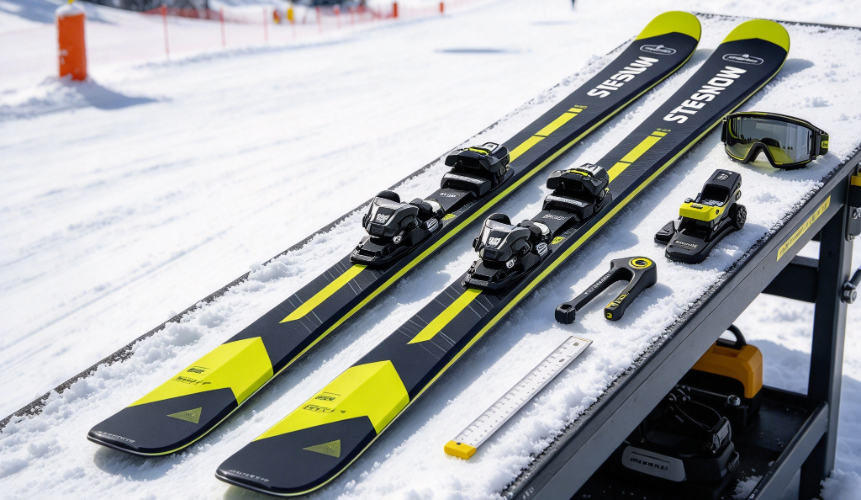
How Tip Rocker Changes the Feel
Tip rocker means the front of the ski rises away from the snow earlier than on a traditional profile. With less of the front edge gripping when the ski is flat, the tip can swing toward a new direction with less effort. The effect shows up in slow turns, in choppy snow, and on softer surfaces where a flat tip tends to dive or catch.
Rocker does not steer for you. Balance, technique, and speed control remain the skier's job. It changes how the ski begins a turn, and it cannot replace sound movement.
Stated length versus effective contact
A ski's stated length is its physical measurement. Its effective contact is the portion that grips under a given load. With rocker, part of the tip lifts when the ski is lightly weighted, so some skiers describe a shorter-feeling ride. Once the ski is tilted and pressured, more edge engages.
Because of this, two skis with the same printed length can feel different. Comparing by the number alone gives an incomplete picture, particularly when moving from a traditional profile to Tip Rocker Skis.
Rocker, sidecut, and flex
These features are easy to confuse, yet each does a separate job.
| Design Feature | Main Role | Effect on Turning |
|---|---|---|
| Tip rocker | Raises the front section | Can ease turn initiation |
| Sidecut | Shapes the outline from tip to waist to tail | Influences the arc when the edge engages |
| Length | Sets overall physical size | Affects leverage and maneuverability |
| Flex | Describes how the ski bends | Shapes response to pressure |
| Width | Sets surface area under the boot | Changes float and edge-to-edge feel |
A ski can pair rocker with a pronounced sidecut for short arcs, or with a straighter shape meant for broader turns. Looking at one feature will not explain the whole experience.
Can rocker offset a longer ski?
Rocker can soften the handling cost of extra length. A longer ski with a rising tip may feel less cumbersome at turn entry, which suits a skier who wants more support without a heavy feel.
It does not remove the physical effects of length, though. A longer ski still needs more room to travel through its arc, and its construction still governs response. The size of the rise matters, and so does the tail shape, which influences how the ski releases at the end of a turn. Judge length and rocker together as one design.
Terrain, Turn Shape, and Final Checks
Open slopes reward a longer ski for broad, steady turns, because the ski feels composed while the skier holds a steady pace. Narrow runs, tree lines, and crowded slopes favor shorter skis that need less room. A longer ski can still turn tightly if the skier moves precisely and the design supports it, but the effort rises.
Groomed runs suit a ski that answers predictably to edge pressure. Softer or changing snow may favor a design that lets the tip float, which rocker can help provide. A skier who spends the week on packed resort trails and a skier who ducks into ungroomed pockets should not shop with the same checklist.
Before buying, work through these points:
- Does the length suit your height and weight?
- Can you guide the ski comfortably at your usual speeds?
- Does the flex match how hard you load a ski?
- Does the sidecut support your preferred turn shape?
- Does the rocker give useful maneuverability for your terrain?
- Is the ski built for the snow you expect?
- Can you keep control when the slope narrows or steepens?
Look at the full profile instead of the length alone. Two pairs of Men's Alpine Skis with the same stated size can feel quite different because rocker, sidecut, flex, and width are not identical. Reading the manufacturer's size guidance helps, and trying demo skis on your home terrain helps more.
A qualified ski retailer or instructor can match these features to your ability and habits. Bring notes on where you ski, how fast you like to go, and which turns give you trouble. The goal is a ski that supports controlled movement on your terrain and feels natural underfoot, not simply a longer or shorter model chosen by one rule.




- Building 1 and 2, No. 2269, Jingzhong Road, Hongjia Street, Taizhou, Zhejiang, China
- +86-18857621312
- [email protected]
