
 English
 русский
 عربى

What Makes Lightweight Inflatable SUP Boards Worth It
2026-11-17
A hard paddle board needs a roof rack, a garage corner, and usually a second pair of hands. For plenty of people, that setup decides whether they paddle at all. A Lightweight Inflatable SUP changes the equation. It packs into a backpack, rides in a car trunk, and goes from bag to water after a short stretch of pumping.
What Makes a Lightweight Inflatable SUP Different
An inflatable board uses a drop-stitch core. Thousands of fine threads join the upper and lower fabric layers, and air pressure pulls them tight. The result is a flat, firm platform that holds its shape under a paddler's weight. Once the air is released, the board rolls up like a sleeping bag.
A Lightweight Stand Up Paddle Board takes that idea and trims unnecessary mass. Weight depends on several choices:
- Fabric and PVC layers: thinner or more efficient laminates reduce weight, but they still need to resist scrapes from rocks and docks.
- Drop-stitch core: the stitch pattern and thread density affect stiffness and thickness.
- Board shape: length, width, and thickness all add or remove material.
- Rails and reinforcement: extra bonded strips protect edges and also add weight.
- Accessories: a compact pump, a collapsible paddle, and a slim bag can change how heavy the full kit feels.
A board is not well designed just because it is light. Cutting material without a plan produces a board that flexes in the middle, feels unstable underfoot, and wears quickly. Good design keeps weight down while preserving stiffness and durability.
Everyday Benefits
Easier Carrying and Loading
Picture a parking lot at a lake. A rigid board has to be lifted overhead, walked down a path, and often shared between two people. A packed Inflatable Stand up Board sits on your back like a hiking pack. That makes solo trips realistic, even for people who do not want to wrestle a long board across gravel or sand.
Loading the car is simpler as well. The bag fits across a back seat or in a trunk, and there are no straps to tighten or racks to buy.
Storage in Small Homes
Apartments rarely have a spare wall for a nine-foot board. Deflated, an inflatable board fits in places such as:
- A hallway closet
- Under a bed or a bench
- A garage shelf
- A car trunk during travel
- A camper or van storage bay
This matters in daily life. Gear that is easy to put away tends to be used often, while gear that blocks the hallway tends to be sold.
A Good Fit for Trips
Campers, RV owners, and road travelers usually fight for space. A packed board sits next to a cooler and a tent without taking over the vehicle. After setting up camp, a short paddle on a nearby lake adds a different kind of day to the trip.
Comparing the Two Board Types
| Feature | Inflatable | Hard Board |
|---|---|---|
| Storage | Folds into a bag | Needs a dedicated spot |
| Transport | Fits in a trunk | Often needs a roof rack |
| Setup | Pumping required | Ready at once |
| Surface feel | Firm but slightly cushioned | Fully rigid |
| Impact tolerance | Bounces off many knocks | Can ding or crack |
Hard boards still suit people who live near the water and paddle often. For everyone else, the inflatable route removes most of the logistics.
Who Benefits From One
Travelers and Campers
Anyone who moves between lakes, coasts, and campsites gains from a board that travels like luggage. A Lightweight Inflatable SUP suits airline trips, train rides, and long drives, provided the packed size fits the carrier's rules.
Solo Paddlers
Many people paddle alone because schedules rarely match. Carrying, inflating, and launching without help is a real advantage. Package weight, bag shape, and strap comfort deserve as much attention as the board itself, since a light board in an awkward bag still feels heavy on a long walk to the shore.
Beginners
New paddlers often prefer inflatables because falling feels less punishing. The soft rails forgive bumps, and the board does not bruise shins the way a hard one can. Beginners should look past weight alone. Width, volume, and rider capacity matter for balance in the early weeks. A wider all-around shape is usually easier to learn on than a narrow touring or racing shape.
Families and Casual Paddlers
A weekend paddle with relatives needs gear that goes away easily afterward. Several packed boards fit in one vehicle, and nobody needs to find roof space for them.
Popular Ways to Use One
- Recreational paddling: calm lakes, slow rivers, and sheltered bays suit an all-around Inflatable Stand up Board.
- Touring: longer, narrower shapes track straighter and cover distance with less effort. Strapping a dry bag onto the deck turns a paddle into a day trip.
- Camping outings: reach a quiet shoreline, watch the evening light, and return without hauling a rigid board.
- Fitness and yoga: wide, stable boards with a soft deck pad make floor-style movements possible. Not every light board offers enough stability for this, so check the width and deck layout before buying for yoga.
Before any outing, check local weather, wind direction, water access rules, and safety requirements. Wear a personal flotation device and attach a leash suited to the water you are on.
How to Choose a Lightweight Stand Up Paddle Board
Separate Three Weights
Product listings use several weight figures, and they are not interchangeable:
- Board weight: the inflatable board alone
- Package weight: board, pump, paddle, fin, bag, and repair kit
- Shipping weight: the number used for freight, usually including cartons
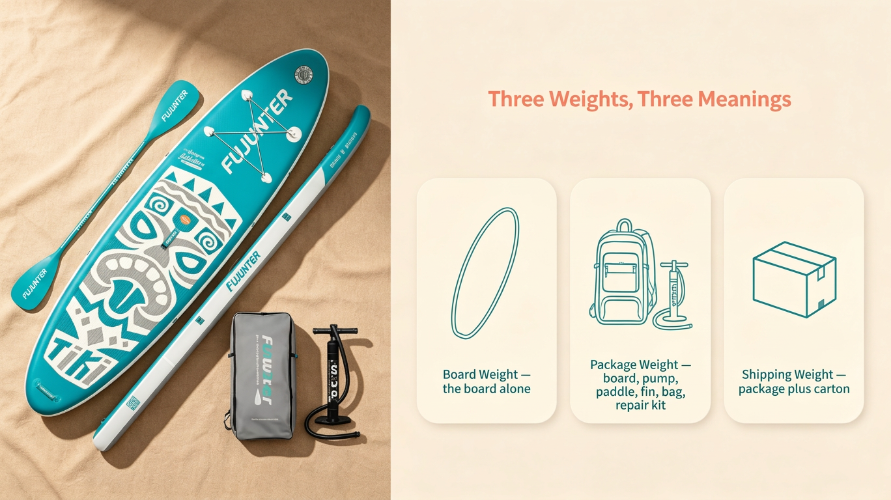
A board may be light while the complete kit feels heavy because of a bulky pump or a thick paddle. If carrying is your priority, compare the package weight, then pick up the loaded bag in a shop if you can.
Read the Dimensions
- Length: longer shapes glide and track better. Shorter shapes turn more easily and pack smaller.
- Width: wider shapes feel steadier, which helps beginners, fitness users, and anyone carrying a pet or gear.
- Thickness: this changes volume and how stiff the board feels when inflated.
Match these to your body weight, skill level, and planned use. A paddler carrying camping gear needs more capacity than someone out for a short evening loop.
Look at Construction
Check the PVC layers, drop-stitch core, rail bonding, seam finish, deck pad, and valve design. Edges should look clean, seams should be even, and the deck pad should be glued without bubbles. A well-made valve opens and seals smoothly, and a spare valve tool should come in the kit.
Follow Inflation Guidance
Each board has a recommended pressure range printed near the valve or in the manual. Staying within that range keeps the board stiff enough to paddle and safe from stress. Never go beyond the limit set by the maker, even if the board still feels soft when you stand on it. A pumped board left in hot sun can build internal pressure, so shade it or release a little air during breaks.
Check What Is Included
A complete package often contains:
- An adjustable paddle
- A hand pump or electric pump
- A removable fin
- A safety leash
- A carry backpack
- A repair kit
Confirm which pieces ship with the board and which are sold separately. A paddle that does not collapse small may defeat the portability you wanted.
Care and Storage
Simple habits extend the life of an inflatable board.
Rinse with fresh water after each outing, particularly after saltwater or muddy shallows. Dry it completely before folding. Damp fabric packed in a bag grows mildew and develops a smell that is hard to remove.
For storage:
- Keep the board out of long direct sunlight
- Avoid hot cars and garages in summer
- Keep it away from sharp tools and rough shelves
- Fold according to the maker's instructions
- Look over the valve, seams, and surface now and then
Before each session, walk around the board and check for scuffs, loose patches, and valve problems. Press a hand on the surface after inflating to confirm it feels firm. A slow leak found on land is a small annoyance. The same leak found far from shore is a bigger problem.
Construction Quality for Buyers and Brands
Weight savings mean little if the board delaminates after a season. Buyers should look at material specifications, core construction, rail reinforcement, and the quality of the bonding work.
For retailers and importers, factory process matters as much as the sample. Useful inspection steps include:
- Raw material checks before cutting
- Seam and bonding inspection
- Air leakage testing
- Inflation and pressure checks
- Final inspection before packing
Consistent testing keeps one batch matching the next, which protects return rates and customer reviews.
OEM and ODM Options
Outdoor brands often want a board that carries their own identity. Customization can include logos, colorways, graphics, accessory sets, retail packaging, and specification development for a target market. An experienced manufacturer can advise on which combinations stay practical, such as a graphic style that survives UV exposure and rubbing against a car trunk.
Common Questions
Are These Boards Suitable for Beginners?
Many are. Look for stable width, adequate volume, and a rider capacity above your body weight plus gear. Weight alone should not decide the purchase.
How Heavy Is a Lightweight Inflatable SUP?
Weight varies with size, materials, and construction. Read the maker's listed board weight and package weight, and compare the same measurement across models.
Is Storage Really Easy?
Yes. After drying, the board folds into its bag and fits in a closet, a trunk, or a camper compartment.
Can Brands Order Custom Designs?
Many manufacturers offer OEM and ODM services, including logos, colors, graphics, accessories, and packaging. Options depend on the factory's capabilities and order size.
Choosing With Confidence
A Lightweight Inflatable SUP removes the usual barriers to paddling: no rack, no garage space, no second person for loading. A sound choice balances stiffness, stability, package weight, and build quality against how and where you plan to paddle. Careful drying and sensible inflation keep the board in service for many seasons. Outdoor brands and distributors can contact an experienced inflatable board manufacturer to discuss product requirements, customization support, and OEM/ODM plans.




- Building 1 and 2, No. 2269, Jingzhong Road, Hongjia Street, Taizhou, Zhejiang, China
- +86-18857621312
- [email protected]
