
 English
 русский
 عربى

How Does Inflatable Stand up Board Width Affect Stability
2026-11-13
Stand-up paddleboarding has become part of a wider outdoor lifestyle, one in which people look for ways to enjoy the water and stay active without handling bulky equipment. Choosing an Inflatable Stand up Board involves more than judging its appearance or carrying weight. Width has a direct effect on how the board feels underfoot, how easily a rider keeps balance, and how comfortably the board moves across the water. For anyone considering a Lightweight Inflatable Sup, understanding that relationship can separate a relaxed outing from a frustrating one. A wider board offers more standing space, while a narrower shape feels more responsive, and neither suits every rider. The right choice depends on body weight, experience, water conditions, and the activities planned.
Why Width Affects Balance
Width determines how much side-to-side movement a rider feels while standing. A wider platform gives a broader area over which to spread weight, which makes it easier to adjust posture and recover from small wobbles. Anyone new to a board notices how unfamiliar tiny movements can feel, and extra deck space gives room for feet and body to settle.
That extra room helps in several ordinary situations: learning to stand and find a centred position, changing direction, shifting posture when the water moves, and carrying a few personal items. It also makes casual paddling more comfortable for riders who like to move around the deck rather than hold one position.
Narrower boards leave less room for lateral movement. Riders must pay closer attention to stance, posture, and paddle technique. Experienced paddlers often like that, because a slimmer shape can reduce resistance when moving forward, depending on the overall design. Stability and efficiency are related but separate qualities, and a board that excels at one may ask for compromise on the other.
Width never works alone. Length influences tracking and turning. Thickness affects volume and how the deck sits relative to the water. Construction decides rigidity, and inflation pressure determines how firmly the board holds its shape. Weight capacity decides whether the board can carry the rider and any extra gear properly. A sound design weighs these together instead of relying on a single measurement.
Wide or Narrow: Matching Style to Shape
The choice often comes down to what a rider wants from time on the water. Some people want a relaxed platform for quiet lakes, and others want a streamlined shape for covering distance.
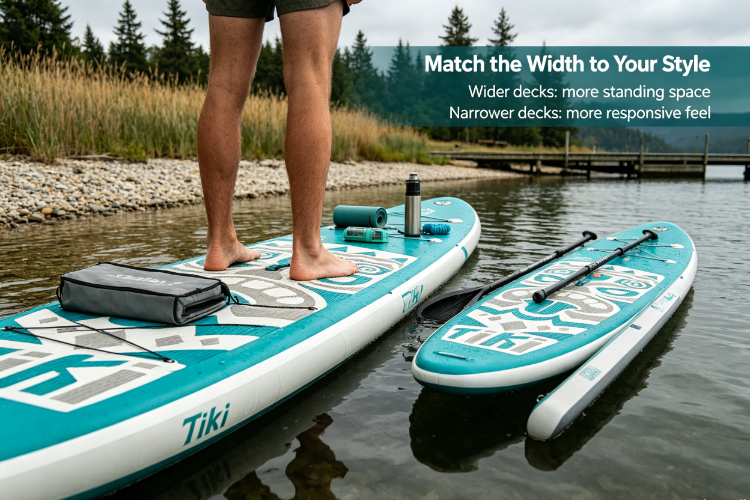
A wider board makes recreational paddling more accessible. Beginners still developing balance, families on calm water, anglers who need space for basic gear, and riders who enjoy yoga or gentle exercise all benefit from the broader deck. A small dry bag fits comfortably too, as long as the total load stays within the manufacturer's capacity.
A narrower board suits paddlers who like a steady rhythm and longer distances. Its shape may cut resistance, although the real experience depends on length, hull form, technique, and conditions. These riders should be comfortable adjusting balance while holding a consistent paddling position.
| Feature | Wider Board | Narrower Board |
|---|---|---|
| Standing space | Broader deck | More limited deck |
| Side-to-side stability | Generally greater | Needs more balance |
| Paddling style | Relaxed, recreational | Distance and performance |
| Beginner comfort | Often easier to approach | Takes practice |
| Gear space | More room for positioning items | More limited |
| Portability | Depends on construction | Depends on construction |
Board width should follow the intended activity. A rider who enjoys easy lake paddling may value deck space, while one who prefers a streamlined feel may choose a slimmer design.
Beginners and Width
For new paddlers, comfort matters more than speed. Learning to stand, hold the paddle, and coordinate movement takes time, and a reasonably wide platform makes those early sessions less demanding. Still, choosing a board because it looks wide is not enough. Its overall dimensions and load capacity must also suit the rider.
Before buying an Inflatable Stand up Board, check how naturally you can stand on the deck. You should be able to place your feet comfortably, keep your knees slightly relaxed, hold a balanced posture, swing the paddle from side to side without feeling restricted, and adjust your position when the water changes. A comfortable stance lets a beginner think about paddling instead of footing.
| Rider Profile | Design Priority |
|---|---|
| New paddlers | Stability and standing comfort |
| Recreational riders | Balance and versatility |
| Regular paddlers | Stability and efficiency |
| Experienced riders | Responsiveness and intended activity |
These are guidelines, not fixed rules. Comfort, body proportions, and water conditions change how any board feels.
Width alone can also give the wrong impression. Excessive width makes paddle placement awkward, particularly for riders with shorter arms or a smaller frame, because reaching across a very broad deck strains the shoulders and disrupts rhythm. A board should feel manageable both standing still and moving.
Weight, Water, and Activity
Two people on the same board can have different experiences. Body weight, posture, technique, and surroundings all shape the response. A board needs enough volume and load capacity to carry the rider without sitting too low in the water. Count body weight, clothing, personal equipment, accessories on the deck, a second person or pet if one comes along, and the manufacturer's recommended loading.
Conditions matter just as much. On a calm lake, the rider can focus on posture and paddle technique. Light wind pushes the board sideways and calls for attention to direction and balance. Small waves move the board beneath the rider, which makes weight distribution important. Coastal water changes constantly and requires suitable experience, preparation, and awareness of local conditions. A wider board adds lateral stability, but it does not cancel wind, current, or waves. Wear a personal flotation device and a leash as local rules and good practice suggest, and check the weather before heading out.
The activity matters too. Recreational paddling calls for a comfortable deck and versatile handling. Fishing wants extra standing space and gear capacity. Yoga needs room to change positions, and touring places more weight on tracking, efficiency, and storage.
Can a Lightweight Board Still Be Stable?
Portable gear has become popular because outdoor activities fit more easily into everyday life when equipment is simple to carry, store, and prepare. A Lightweight Inflatable Sup does not give up stability merely because it is light. Shape, internal structure, inflation pressure, and volume govern how it behaves on the water.
Carrying weight and on-water stability are different things. Weight describes how heavy the board is to lift. Stability describes how it reacts when a rider stands, moves, or shifts weight. A light board can feel steady when its construction supports the rider and holds its intended shape in use. When comparing products, look past the weight in the description.
Several features help a light board stay steady. A suitable width gives standing space and natural weight distribution. Adequate volume supports the rider and carried gear. Consistent construction helps the board retain its shape. Proper inflation, following the maker's instructions, preserves rigidity, and a practical deck with sensible foot placement makes standing and repositioning natural.
Transport counts as part of ownership. An inflatable board is easier to move between car, storage, and launch point, and when packed correctly it takes less room than a rigid one. For people who like spontaneous outings, quick preparation makes paddling easier to fit into a routine.
Choosing a Board
Start with intended activities rather than comparing specifications in the abstract. A board built for relaxed recreation differs from one built for distance.
Think about experience. If you are new, prioritise a stable platform and a manageable stance, and if you are more experienced, a design that responds naturally to paddle strokes may appeal. Consider whether you will paddle now and then or regularly.
| Activity | Design Considerations |
|---|---|
| Recreational paddling | Comfortable width, versatile handling |
| Yoga | Spacious deck, steady platform |
| Fishing | Standing space and gear capacity |
| Touring | Efficient shape, suitable storage |
| Family outings | Load capacity, comfortable positioning |
Then read the full specification. Check whether the width and length suit your body and activity, whether the capacity covers your expected load, what the materials and structure are, which inflation pressure the maker recommends, how heavy the packed bag feels to carry, and what comes in the package, such as paddle, pump, fin, and backpack. Review warranty and care guidance too.
A few mistakes are common. People assume wider is always better, although extra width can add resistance and make paddling less comfortable. They choose by carrying weight alone, which says nothing about performance. They ignore total load, and they overlook inflation and care. Follow the inflation instructions, inspect the surface and valves, and store the board properly after each outing.
Choosing an Inflatable Stand up Board starts with how you want to use the water. Whether the plan is quiet lake paddling, exercise, fishing, or exploring, width influences comfort and confidence, and a Lightweight Inflatable Sup adds the convenience of easy transport and storage. A suitable width, adequate capacity, dependable construction, and manageable carrying weight together make a board that fits the rider.




- Building 1 and 2, No. 2269, Jingzhong Road, Hongjia Street, Taizhou, Zhejiang, China
- +86-18857621312
- [email protected]
