
 English
 русский
 عربى

What Makes a Lightweight Stand Up Paddle Board Portable
2026-11-20
Recreational paddling depends on more than time spent on the water. Moving equipment from storage to the vehicle, from the vehicle to the shoreline, and back again takes real effort. A Lightweight Stand Up Paddle Board reduces that effort through lower carrying demands, compact packing, and simpler storage. For travelers, families, and anyone without a garage or roof rack, these practical points often decide whether paddle boarding becomes a regular activity.
Why Weight Matters in a Lightweight Stand Up Paddle Board
Weight affects every stage of a paddling session. Lifting the board from storage, loading it into a car, walking across a beach, and putting it away afterward all take physical effort. A lighter board reduces strain at each stage, which matters for people who handle their equipment alone.
Rigid boards are difficult to move through narrow hallways, tight parking areas, and crowded sand. They also need a protected storage space, and many homes cannot spare one. An inflatable, lighter build removes much of that burden and suits several groups of users:
- Solo paddlers who load and carry their own equipment
- Beginners who want a manageable start
- Families who already carry beach gear, food, and clothing
- Travelers who pack around luggage and other equipment
Board weight alone does not determine portability. Handles, bags, fins, and accessories all shape how convenient the complete package feels in daily use.
| Design Feature | Contribution to Portability |
|---|---|
| Lightweight construction | Reduces carrying effort |
| Inflatable structure | Allows compact storage after deflation |
| Comfortable handle | Eases short carries |
| Dedicated backpack | Keeps board and accessories together |
| Removable fin | Simplifies packing and storage |
Reviewing these features together gives a more accurate view of convenience than a single weight figure. Buyers who compare complete packages tend to find fewer surprises after purchase.
Carrying Comfort and Backpack Design for a Lightweight Stand Up Paddle Board
Many shoreline access points sit some distance from parking. A board packed in a backpack can travel along a trail, across open sand, or through a marked entry point without anyone handling a long rigid shape. Comfort on that walk depends on design details that are easy to overlook in a product listing.
Useful features include:
- Padded shoulder straps that spread the load across the back
- Reinforced handles for lifting and short carries
- Adjustable straps that fit different body sizes
- Compartments for the paddle, leash, and smaller items
- Secure fastening that keeps packed equipment from shifting
A bag with poor strap placement can make a light board feel heavy over a longer walk. A bag with sensible structure keeps the weight close to the body and leaves the arms free.
Easy handling also changes how often people go out. When setup and transport take little effort, a short evening paddle becomes realistic, and beginners feel less discouraged about returning to the activity.
Inflatable Construction and Travel Use of a Lightweight Stand Up Paddle Board
An inflatable board does not have to stay at riding size during transport. After a session it can be cleaned, dried, deflated, and rolled into a bag. Following a consistent routine also protects the material over time.
The usual packing process looks like this:
- Prepare the board: remove the paddle, leash, and detachable fin.
- Release the air: open the valve according to the manufacturer's instructions.
- Clean the surface: wipe away sand, dirt, and moisture.
- Roll the board: follow the recommended direction to avoid stress on seams and folds.
- Pack the equipment: place the board and compatible accessories in the carrying bag.
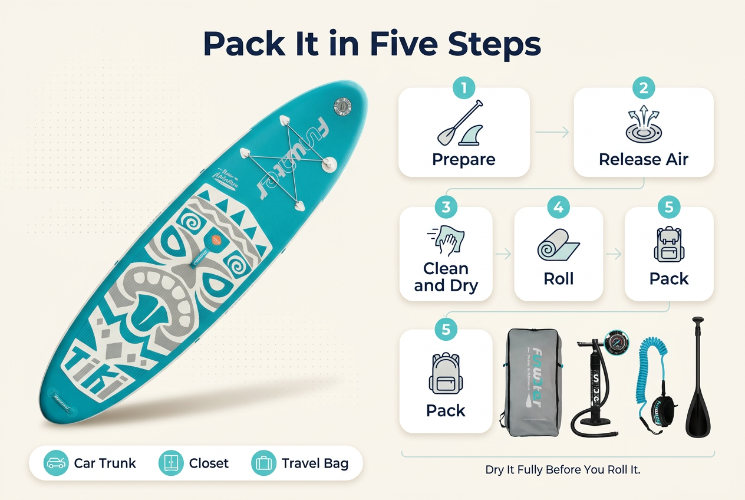
Road trips become easier to organize with this approach. Vehicle space is shared with luggage, camping supplies, and food, and a rigid board often needs external mounting hardware. A properly packed inflatable can generally ride inside the vehicle, although actual fit depends on board dimensions, accessories, and bag size.
| Situation | Rigid Board | Inflatable Board |
|---|---|---|
| Car transport | Often mounted outside | Can fit inside a suitable space |
| Camping | Occupies substantial room | Packs with other gear |
| Home storage | Needs a dedicated area | Stores in its bag |
| Solo handling | Awkward to move | Easier when packed |
Travelers who prefer familiar equipment can bring their own board instead of relying on rentals. For air travel, review airline policies on baggage dimensions and weight before packing, since rules vary between carriers.
Home Storage Advantages of a Lightweight Stand Up Paddle Board
Apartment and shared-housing residents rarely have room for a full-length rigid board. A cleaned, dry inflatable can be rolled into its bag and placed in a cabinet, closet, utility room, garage shelf, or vehicle compartment. This flexibility lets people keep paddling equipment without giving up living space.
Moisture needs attention during storage. A board packed away damp can develop odors and material problems, so allow it to dry fully before rolling. Store the bag away from direct heat and sharp objects, and follow the manufacturer's storage instructions.
Keeping accessories together also saves time. The paddle, pump, fin, leash, and repair kit are easier to locate when they live in one bag. A well-designed carrying bag holds the board and compatible accessories without forcing the zipper shut, which reduces wear on both the bag and the material inside.
Beginners and Families Using a Lightweight Stand Up Paddle Board
New paddlers need time to learn balance, stroke technique, and how water conditions affect the board. Equipment that is easy to transport removes one obstacle before the lesson even begins. Portability should never replace stability, so beginners should check several points when selecting a board:
- A width suited to recreational stability
- Enough buoyancy for the rider's size and gear
- A comfortable deck with reliable traction
- A carrying system that matches the user's strength
- Accessories that simplify inflation and setup
Families gain similar benefits. A compact board fits into a trip without a separate transport plan, which helps when the trunk is already filled with coolers and beach bags. Choose a board according to its stated weight capacity and intended use. Children should be supervised near water and wear suitable flotation equipment at all times.
| User Type | Key Considerations |
|---|---|
| Beginners | Stability, comfortable deck, easy handling |
| Solo paddlers | Carrying comfort, manageable packed weight |
| Families | Weight capacity, board dimensions |
| Campers | Compact storage, accessory organization |
| Travelers | Packed dimensions, transport rules |
Matching the board to the person using it keeps lightweight construction practical instead of merely convenient on paper.
Where a Lightweight Stand Up Paddle Board Fits Into Outdoor Plans
A portable board adapts to many destinations. The right setting depends on water conditions, local rules, and the experience of the paddler.
- Beach vacations: The board packs with other beach gear and can be inflated on arrival when conditions are suitable. After the trip, it returns home in the same bag.
- Camping trips: Store the board beside tents and cooking equipment, then combine paddling with hiking or fishing. Check local access rules, weather, and restrictions before setting out.
- Calm lakes: Sheltered water suits basic technique practice and relaxed family outings.
- Remote shores: Where parking sits far from the water, a backpack-style board makes the walk to an approved access point more manageable.
Planning matters in each case. Review the forecast, wind direction, water traffic, and local regulations, and tell someone where you intend to paddle.
Inflatable and Rigid Boards: Choosing the Right Lightweight Stand Up Paddle Board Format
Both formats have legitimate uses. The better choice depends on how the owner plans to transport, store, and use the equipment.
| Aspect | Inflatable | Rigid |
|---|---|---|
| Carrying | Convenient in a backpack | Full board must be handled |
| Storage | Deflates and rolls | Needs room for its full shape |
| Transport | Fits many car layouts | Often carried externally |
| Preparation | Needs inflation before use | Ready once equipped |
An inflatable board suits people with limited storage, regular car travel, and a preference for carrying gear alone. A rigid board suits owners who have convenient storage, a roof rack, and a short route to the water. Some paddlers also prefer the immediate readiness and on-water feel of rigid construction.
Neither format suits every situation. Consider how far you carry the board, where it sleeps between trips, and how much time you want to spend on setup.
How to Choose a Lightweight Stand Up Paddle Board for Real Use
Product pages often emphasize low weight while leaving out details that affect daily convenience. A careful review covers several areas:
- Actual carrying weight: Separate board weight from complete package weight. The pump, paddle, backpack, and fin all add to what you carry.
- Dimensions and capacity: Length, width, and thickness influence stability and tracking. Check the recommended weight capacity against the rider and any gear.
- Materials and construction: Review the outer PVC material, drop-stitch core, reinforced seams, rail protection, deck pad, and valve quality. A lighter board does not automatically offer sufficient durability.
- Complete package: Examine backpack comfort, pump compatibility, paddle storage, fin design, handles, and repair items.
Reading specifications closely and comparing complete packages helps avoid equipment that is light in name but awkward in practice. Reviews from users who carry the board regularly can add useful context about strap comfort and bag design.
OEM and Wholesale Considerations for Lightweight Stand Up Paddle Board Products
For SUP brands, retailers, and distributors, portability is a core product development topic. A Lightweight Stand Up Paddle Board must balance materials, construction methods, carrying accessories, and the needs of the intended customer. A beginner-focused model may emphasize stability and simple handling, while a travel-oriented model may emphasize compact storage and a refined carrying system.
Businesses exploring wholesale or OEM projects should discuss several points with a manufacturer:
- Board dimensions and construction options
- Color schemes and graphic customization
- Brand logo placement
- Backpack and accessory configurations
- Packaging requirements
- Specifications suited to different sales channels
Clear technical information also helps retailers prepare accurate listings and product photography. When buyers understand carrying method, packed size, and accessory content before purchase, return rates and service questions tend to decrease.
Contact Our Team About Lightweight Stand Up Paddle Board Solutions
A Lightweight Stand Up Paddle Board supports solo paddling, family recreation, lakeside camping, and beach travel through easier handling and compact storage. The right configuration depends on available storage, transport arrangements, paddling experience, and the destinations a user visits most often.
Our team welcomes inquiries about inflatable board designs, accessory packages, OEM customization, and wholesale supply. Share your target market, preferred specifications, and packaging requirements, and we will work with you on a configuration that fits your product range.





- Building 1 and 2, No. 2269, Jingzhong Road, Hongjia Street, Taizhou, Zhejiang, China
- +86-18857621312
- [email protected]
