
 English
 русский
 عربى

How to Drive an Off Road Farm UTV Safely on Slopes
2026-10-23
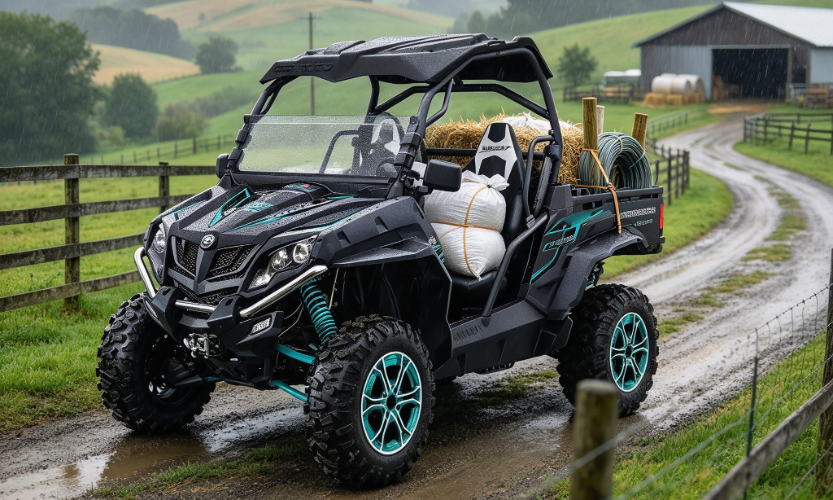
Picture a wet morning on a hillside farm. A vehicle carries fence posts, a roll of wire, and a few bags of feed toward a far paddock. The same trip on dry, flat ground feels routine. On a slope, with weight behind the driver, every steering input, brake press, and turn behaves differently.
An Off Road Farm UTV moves supplies between fields, barns, and repair sites, but slopes ask more of the driver. Load placement, speed, and route choice work together. A well-secured load cannot rescue a bad slope, and a good route will not help if the cargo shifts halfway up.
Why Slopes Change How a Loaded Vehicle Behaves
Cargo adds weight the vehicle must carry up, hold back going down, and keep balanced through turns. The tires also need grip to steer and brake. Loose soil, wet grass, and gravel reduce that grip.
Uphill, the vehicle needs enough traction to move its combined weight. Downhill, the driver must control forward movement without hard braking. A load that sits high or slides sideways changes balance and can distract the driver.
| Condition | Main Concern |
|---|---|
| Uphill | Traction, steady movement, load position |
| Downhill | Controlled speed, braking, available grip |
| Side slope | Balance and tipping risk |
| Uneven ground | Wheel contact and cargo stability |
| Loose surface | Traction and stopping room |
Judging a slope by eye is not enough. Check its surface, direction, and the space at the top and bottom.
Loading Before You Climb
Keep heavy items low and secure them as the manufacturer instructs. Stay within the stated carrying limits for the bed and the vehicle. Loading everything to one side, or piling weight over the rear or front, changes how the UTV steers and brakes. A bed that looks evenly filled is not automatically safe.
Avoid stacking tall just to save floor space. A taller load raises the center of gravity and can catch on branches along narrow tracks. Smaller items can fill gaps only if they do not let the main load shift.
Run through a short check before leaving:
- Heavy items sit low and are restrained.
- Straps or tie-downs stop sliding.
- The load does not block the driver's view or controls.
- Total weight stays within manufacturer limits.
- Nothing loose can fall out of the bed.
Cargo that looks steady while parked can move once a wheel drops into a rut. If it cannot be secured properly, make two trips.
Going Uphill and Downhill
Uphill
Pick a route that suits the load and the ground, not simply the shortest line. Approach at a controlled pace and apply the accelerator smoothly, since sudden power can break traction on loose soil. Stopping halfway up can leave the vehicle unable to restart safely.
Look ahead for ruts, rocks, wet patches, and abrupt changes in grade. If the path looks wrong for the load, choose another instead of adding speed. Respect the slope limits in the owner's manual. If traction slips, avoid sharp steering and hard acceleration, and follow the manufacturer's guidance.
Downhill
Gravity does the pushing, so the driver must manage the descent. A heavy load takes more effort to slow, and a wet or loose surface gives less grip. Hard braking can cause sliding, particularly with unsecured cargo.
Reduce speed on firm ground before the slope begins. Use the driving mode or gear the manufacturer recommends, and the braking method described in the manual. Think about what waits at the bottom: a tight turn, a ditch, a gate, or a soft patch. A gentler descent with a clear exit is often better, even if it takes longer.
| Downhill Concern | Safer Approach |
|---|---|
| Loose surface | Judge traction before entering |
| Heavy cargo | Secure the load, respect limits |
| Sharp turn below | Slow down before the descent |
| Uneven ground | Confirm the route suits the vehicle |
| Little stopping room | Choose a path with space to slow |
The parking brake and sudden stops are not substitutes for controlled driving. If the descent is too steep for the load, move the cargo another way.
Speed, Route, and Side Slopes
Speed decides how much time you have to react to a rut, rock, soft patch, or turn. A loaded vehicle also needs more room to stop, and no single pace suits every route. Drive smoothly, slow before turns and slopes rather than after entering them, and keep enough space to stop within the clear distance ahead, especially where someone could step onto the track.
A direct path may cross steep ground, soft soil, or narrow turns. Review these before setting off:
- Slope direction and steepness
- Surface condition and traction
- Path width and turning space
- Rocks, branches, ditches, and gates
- Room to stop or change direction
- Conditions at the unloading point
A path that works in dry weather can turn slick after rain. Keep routes away from livestock, workers, and machinery where possible.
Crossing a side slope with a full bed adds tipping risk, since gravity pulls toward the lower side and a tall load raises the danger. Do not attempt a steep cross-slope unless the manufacturer permits it and conditions suit it. Avoid sharp turns on the slope. If the route is unsafe, stop somewhere stable and rethink it. No one should ride in the cargo bed unless the vehicle is specifically designed and approved for it.
Checks, Shifting Loads, and Farm Habits
Inspect the vehicle before it carries weight onto a slope.
| Area | What to Check |
|---|---|
| Tires | Visible damage and condition |
| Brakes | Normal operation, any warning signs |
| Steering | Normal response, no damage |
| Cargo | Secure placement and distribution |
| Attachments | Correct installation and use |
| Route | Ground, slope, available space |
Do not start out with a mechanical fault or an unsecured load. A winch or other accessory is not a replacement for sound route choice.
If cargo shifts mid-trip, avoid sudden corrections. Stop in a stable spot when it is safe, secure the vehicle as instructed, and re-fasten the load before moving. Never reach into an unstable bed or adjust heavy items while rolling. Check the load again after any stop where it could have moved.
Familiar routes breed complacency, yet ground and loads change from trip to trip. Farm teams can set simple habits: loading rules, a quick route check, and a handover note when a vehicle changes hands. Drivers should know the carrying limits, report faults in steering, braking, or traction, and receive proper training before working on slopes. Keep bystanders clear of the vehicle's path and never stand below a loaded UTV on a hillside. Careful loading, an adjusted pace, and a sensible route let an Off Road Farm UTV do its work on rising ground without surprises.








- Building 1 and 2, No. 2269, Jingzhong Road, Hongjia Street, Taizhou, Zhejiang, China
- +86-18857621312
- [email protected]
