
 English
 русский
 عربى

How Can Sightseeing Carts Balance Capacity and Comfort
2026-11-10
Picture a hotel porter on a busy Saturday afternoon. A family of five has arrived with two suitcases, a stroller, and a grandmother who walks slowly. The cart waiting at the entrance has seats for all of them, but once everyone climbs in, knees press against the seat in front and the bags have nowhere to go. Nobody complains out loud, yet the ride across the grounds feels longer than it should.
This is the real question behind choosing an Electric Sightseeing Cart. Seat count is easy to read from a brochure. Comfort is harder to see, and it depends on how the space is arranged, how the vehicle rides, and how people get on and off.
What Capacity Really Means
Capacity describes how many people a cart can carry, but it says little about how they will feel on board. A resort might move couples between the lobby and the spa, while a scenic park moves tour groups between a car park and a viewpoint. A theme park deals with strollers, backpacks, and visitors who board and leave every few minutes. Each of these places asks something different from a vehicle.
A Passenger Golf Cart suits sites where narrow paths and tight parking are normal and groups are small. A Multi Passenger Golf Cart makes more sense where organized groups move together and the route is wide enough for a longer body. Choosing between them starts with a few honest questions. How many people usually ride at once? Do they carry luggage? How long is a typical trip? Are there children, older guests, or visitors who need help stepping up?
Answering these before looking at models prevents a common mistake, which is buying for the busiest day of the year and living with an oversized vehicle the rest of the time.
Seats, Legroom, and Layout
The way seats are arranged matters more than how many there are. Forward-facing rows feel familiar and calm. Opposing seats suit sightseeing, because guests can talk and look at the view, although they need enough space between knees. Rear-facing seats add flexibility in some models. Multi-row designs carry bigger groups but require wider entry space so people don't squeeze past each other.
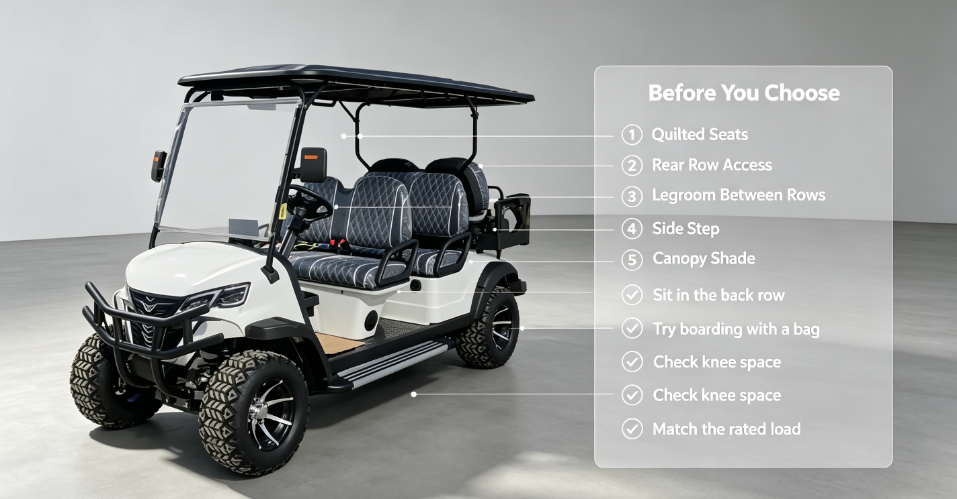
Before buying, sit in the cart yourself. Check how far the seat in front is from your knees, where your feet go, and whether the seat is wide enough for an adult in a coat. Try getting into the back row with a bag in your hand. If that feels awkward for you, it will feel worse for a guest with a child on their lap.
Seat quality matters too. Cushion thickness, backrest height, and the presence of armrests all change how a twenty-minute ride feels. For a business with constant turnover, the surface should wipe clean easily and resist wear from sunscreen, spilled drinks, and damp swimwear.
How the Cart Rides
Seats are only part of comfort. A cart that bounces over every joint in a paved path will wear out guests quickly, however soft the cushions look. Suspension and tires deal with vibration, and they should suit the actual route. Smooth resort paths are different from gravel tracks in a garden or a slope beside a lake.
The honest test is a trial run. Ask to drive the cart on a surface like your own, with a load similar to what you expect. Notice how it feels when it corners, when it brakes, and when the rear seats carry weight. Stability under a full load is something a showroom floor cannot show you.
Matching Size to Place
A longer body doesn't automatically mean a roomier ride. What counts is how the space is used: the distance between rows, the footwell, the gap for stepping in, and the way weight is placed. A well-planned smaller cart can feel more generous than a long one with poor layout.
The destination matters as well. A big Multi Passenger Golf Cart can seat a tour group nicely, yet it may struggle on narrow lanes, tight bends, or crowded pedestrian zones. Walk the route before you decide. Look at path width, turning room, slopes, crossings, and pickup points. If a bend is awkward for a person pushing a wheelbarrow, it may be awkward for a long cart.
Weight needs attention too. Seat count and rated load are two different things. People, bags, and equipment all add up, and the manufacturer's limit applies to the total. Spread passengers according to the seating plan, keep luggage out of the way of boarding, and never assume that a free seat means free capacity.
Small Features That Change the Experience
Some additions look minor in a catalogue and matter a lot in daily use. A canopy gives shade on hot afternoons and keeps light rain off guests. Handrails help older passengers climb in. Side protection makes children and nervous riders feel secure. Clear, low entry steps speed up boarding, which matters when a queue is waiting.
Which of these you need depends on climate and route. A cart that runs in a sunny coastal resort has different needs from one in a misty hill park. Think about weather, the age of your guests, and the rhythm of arrivals before you tick boxes on an order form.
Passenger Golf Cart or Multi Passenger Golf Cart
Passenger Golf Cart
A Passenger Golf Cart is flexible. It copes with narrow internal roads, small parking areas, and short transfers between nearby buildings. Hotels, private communities, and small groups benefit from that nimbleness. When comparing models, look at seating comfort, overall dimensions, battery performance, and permitted load rather than counting seats alone.
Multi Passenger Golf Cart
A Multi Passenger Golf Cart is built around group transport. It suits scenic attractions, large resorts, theme parks, and commercial sites with shuttle routes. The longer layout calls for more attention to seat spacing, braking, stability, and how people board. It also needs more room to turn, so the road network has to support it.
Neither is better in every situation. The right choice follows passenger demand, route conditions, and the style of service you want to offer. Some operators keep both, using the smaller cart for individual transfers and the larger one for scheduled group runs.
Different Places, Different Needs
Scenic Areas
Scenic areas often mix viewpoints, visitor centres, footpaths, and uneven ground. An Electric Sightseeing Cart in that setting should handle changes in gradient, offer comfortable seating for longer rides, and carry enough battery for the planned loop. It should also work for visitors with limited mobility, who often appreciate low steps and firm handholds.
Hotels and Resorts
Hotels and resorts move guests between rooms, restaurants, pools, and activity areas. Guests arrive with children and bags, so access space and luggage handling count as much as seats. Weather cover is useful, and the service should feel consistent whichever cart turns up.
Theme Parks
Theme parks see demand rise and fall through the day. A Multi Passenger Golf Cart can link car parks, gates, attractions, and service areas, yet pedestrian flow needs careful thought. Marked routes, clear loading zones, and sensible timing reduce crowding and keep guests safe.
What to Check Before Buying
Start with the manufacturer's technical information. Look at rated passenger capacity, permitted load, dimensions, motor, battery type, braking, suspension, and charging needs. If seat count and load limit are listed separately, ask for clarification so the figures make sense together.
Then see the cart in person. Photographs show the outside, but they cannot show how it feels to sit in the back row. Check seat width, backrest support, legroom in each row, ease of getting in and out, handrail position, and how the suspension responds on a test surface. If you can, drive it with a group of staff on board, staying within the permitted load.
Finally, ask about customization and support. Many suppliers offer different seating layouts, materials, colours, canopy options, and branding. Find out how spare parts are supplied, what maintenance advice is given, and how quickly questions are answered. Sharing details of your passenger numbers, route conditions, and preferred layout helps a supplier recommend something that fits.
Running the Service Well
A good cart still needs good habits around it. Think about who rides regularly, whether families, tour groups, hotel guests, or visitors who need extra help. Map your routes, noting surfaces, bends, slopes, crossings, and pickup spots. Choose a layout that carries your usual groups without exceeding limits, and keep boarding areas clear so bags don't block the way.
Daily checks pay off. Look at tires, brakes, seats, battery condition, and protective features, following the manufacturer's advice. Ask drivers and guests how the ride feels, because they notice things a spec sheet never will. A small adjustment to seating, a different pickup point, or a slower route past a bumpy patch can make the same cart feel much better.
The balance between capacity and comfort isn't fixed. It shifts with your site, your guests, and the season, and good results come from watching how people actually ride.





- Building 1 and 2, No. 2269, Jingzhong Road, Hongjia Street, Taizhou, Zhejiang, China
- +86-18857621312
- [email protected]
