
 English
 русский
 عربى

How Does Climbing Ability Affect an Electric Sightseeing Cart
2026-11-06
A scenic park rarely lies flat. A ramp leads up to a viewing deck, a service road climbs toward a hillside temple, and a resort entrance may tilt toward the lobby. An Electric Sightseeing Cart that glides along a level path can behave quite differently once it carries a full row of visitors uphill. Climbing ability affects passenger comfort, travel pace, route planning, and daily upkeep, so it deserves attention before a purchase is made.
Why Is Climbing Ability Important for Sightseeing Routes?
Many sites combine open pathways with raised platforms, sloping entrances, and connecting roads between attractions. Visitors move across these areas all day, and the vehicle works against gravity each time it goes uphill, carrying its own weight plus passengers and their bags.
Route planning is affected too. If a cart struggles on certain slopes, operators may have to avoid those paths or arrange another form of transport, which makes visits less convenient on large properties.
| Route Condition | Effect on Cart Operation |
|---|---|
| Flat pathways | Routine passenger movement |
| Gentle slopes | Requires steady uphill travel |
| Uneven inclines | Places more demand on traction and control |
| Sloping entrances | Needs careful approach and stopping |
| Hilly connecting roads | Influences route choice and travel time |
A cart should be judged against the terrain it will meet in daily service, not against its performance on a level test lane.
How Does Climbing Ability Affect Passenger Comfort?
Comfort depends on how smoothly the cart moves. Uphill, passengers notice changes in acceleration, body movement, and motor noise. If the cart slows unevenly or hesitates, the ride feels less relaxed.
Sightseeing passengers include children, older visitors, families with strollers, and people unfamiliar with the site. They expect a calm trip that lets them look around. Sudden changes in speed unsettle them, so a controlled, even response matters on routes with several slopes.
Seating adds to the experience. Seat support, legroom, handholds, and row layout shape how people feel during an uphill trip. These features do not replace climbing capability, but they work alongside it.
Boarding on sloping ground needs thought as well. The cart should stop securely in a suitable spot, and the loading area should be arranged so passengers do not step onto an incline.
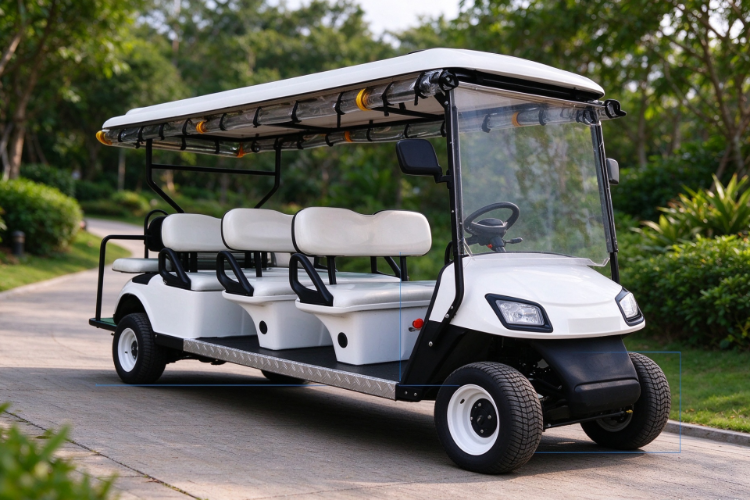
What Factors Influence a Cart’s Ability to Climb?
Climbing performance cannot be read from the motor or the body style alone. Weight, tires, drive arrangement, power system, and passenger load all take part.
Total weight is the starting point. The cart’s own structure, passengers, and permitted belongings add up, and a heavier load affects acceleration and the ability to hold a steady pace uphill. Tire design affects traction on loose or sloping ground, where wheel slip can interrupt forward movement. The power system sets how the cart responds when extra effort is required, and a vehicle built mainly for flat paths may not suit a site with frequent climbs.
| Design Factor | Why It Matters |
|---|---|
| Vehicle weight | Sets the load the power system must move |
| Passenger capacity | Affects total operating weight |
| Tire design | Maintains contact with the surface |
| Drive arrangement | Shapes how force reaches the wheels |
| Power system | Affects uphill response |
| Weight distribution | Influences stability and traction |
These factors work together. A suitable power system still performs poorly if the tires or weight balance do not match the terrain.
Does Passenger Capacity Change Climbing Performance?
Operators like to move groups together because it reduces repeated trips. More seats, however, change the load on the vehicle. A Multi Passenger Golf Cart is built to carry several people, which suits resort transfers, scenic routes, and group visits, but its capacity should be compared with the slopes on the route.
A full group changes uphill behavior compared with two or three riders in the same cart. Acceleration may feel different, and holding a steady pace may take more effort. Seating should follow the manufacturer’s instructions, and the cart should never carry more people or luggage than permitted, since overloading affects handling, braking, and stability on slopes.
| Passenger Use | Climbing Consideration |
|---|---|
| Light load | Less demand on uphill movement |
| Regular group travel | Capacity should suit routine routes |
| Full load | Raises total weight carried |
| Passengers with luggage | Adds to operating load |
More seats do not automatically make a cart suitable for every hillside route. The design must handle the combined demands of capacity, terrain, and daily use.
How Do Tires and Traction Affect Uphill Travel?
Tires are the only contact between cart and road. On clean, dry pavement, grip is fairly predictable. Loose gravel, damp paving, wet grass, and dusty paths reduce traction, and uphill travel exposes the difference quickly. If the wheels lose grip, the cart may move unevenly or stall.
Tire choice should reflect the surfaces on the route. A cart used on paved resort paths has different needs from one running over mixed ground in a large park. Regular inspection helps, since worn tread, uneven wear, wrong pressure, or visible damage change how the vehicle handles. Follow the manufacturer’s advice on selection, pressure checks, and replacement.
Route condition matters as well. Loose material, standing water, damaged surfaces, and sharp changes in gradient create challenges that vehicle design cannot remove, so keeping paths maintained supports safe climbing.
Why Do Braking and Stability Matter on Slopes?
A cart that climbs must also slow and stop with confidence. Going downhill, gravity adds speed unless the driver controls it, so the braking system needs to respond predictably under the conditions the vehicle was designed for.
Stability depends on passenger position, vehicle design, surface, and turning direction. A sharp turn on a sloping road creates extra handling demands. Practical habits help:
- Choose routes that match the vehicle’s intended conditions.
- Reduce speed before slopes and turning areas.
- Avoid sudden acceleration and braking.
- Keep passengers seated while moving.
- Stay within permitted passenger and load limits.
- Stop only in suitable places where the cart stays secure.
- Follow the manufacturer’s guidance for uphill and downhill operation.
Driver training on the actual routes adds value. Knowing where slopes begin, where visibility is poor, and where safe stopping areas lie reduces surprises.
How Should Operators Compare an Electric Sightseeing Cart and a Passenger Golf Cart?
The two vehicle types look alike, yet their intended uses vary. An Electric Sightseeing Cart is commonly chosen for quiet passenger transport around parks, resorts, campuses, and visitor facilities. A Passenger Golf Cart may serve short-distance transport as well, depending on seating layout and application.
Names alone do not decide climbing performance. A cart for a flat resort path has different requirements from one that runs between hillside attractions every hour.
| Factor | Electric Sightseeing Cart | Passenger Golf Cart |
|---|---|---|
| Common use | Visitor transport at designated sites | Short-distance passenger movement |
| Seating | Depends on configuration | Depends on configuration |
| Route fit | Should match site terrain | Should match site terrain |
| Passenger load | Within permitted capacity | Within permitted capacity |
| Climbing needs | Should reflect regular uphill routes | Should reflect regular uphill routes |
Compare specific models instead of assuming one category always performs better. A route assessment helps: list the slopes, surfaces, turning areas, and stopping points the cart will meet during normal service.
What Should Buyers Check Before Choosing for Hilly Areas?
Start with the site. Shuttles, guided tours, resort transfers, and attraction links each create different demands. Map uphill sections, downhill paths, narrow roads, uneven surfaces, and stopping areas, then estimate the usual passenger load.
Discuss these details with the supplier before choosing a model, because general descriptions rarely explain behavior at a particular site. Useful questions include:
- Is the vehicle intended for the site’s slopes and surfaces?
- How does climbing performance change with a full passenger load?
- Which conditions are recommended for uphill and downhill travel?
- Does the braking system suit the planned routes?
- Which tire options fit the site’s surfaces?
- Which maintenance checks apply to regular use on slopes?
- Are there operating restrictions drivers should know?
Where possible, arrange a trial on a representative route, following the supplier’s safety instructions and using a suitable passenger load. Maintenance and after-sales support deserve attention, since hilly service wears brakes, tires, and drive parts differently from flat use. Clear guidance on inspections, parts, and driver procedures supports steady operation.
The decision should reflect the whole transport task. Climbing ability, capacity, comfort, traction, braking, route design, and upkeep together show whether an Electric Sightseeing Cart, a Passenger Golf Cart, or a Multi Passenger Golf Cart suits the environment.







- Building 1 and 2, No. 2269, Jingzhong Road, Hongjia Street, Taizhou, Zhejiang, China
- +86-18857621312
- [email protected]
