
 English
 русский
 عربى

How Does a Passenger Golf Cart Differ From Fuel Vehicles
2026-10-30
Picture a resort on a warm afternoon. A couple rolls their suitcases toward a small electric cart waiting outside the lobby. Down the road, a tour group climbs into a larger fuel-powered vehicle bound for a lookout across the property. Both vehicles carry passengers, yet they do different jobs, and the gap shows up in noise, upkeep, scheduling, and daily handling.
A Passenger Golf Cart suits short hops on internal roads and approved paths. A fuel-powered sightseeing vehicle tends to fit routes that need more seats or longer distances. Power source, size, and service demands all differ. Looking at the real route before choosing saves operators a good deal of trouble later.
Why Do the Two Vehicle Types Serve Different Needs?
A compact cart is a natural fit for linking a parking lot to a visitor center, or a hotel lobby to a spa. It slips into narrow spaces and pulls up close to a doorway. Fuel-powered sightseeing vehicles cover a wider range, from small utility-based models to buses built for groups, and they suit loops that pass through several distant attractions.
Size alone should not settle the question. A small vehicle turns easily but carries fewer people per trip. A big one moves a whole tour party together but can feel clumsy on a lane shared with strollers and wheelchairs.
| Comparison Area | Passenger Golf Cart | Fuel Sightseeing Vehicle |
|---|---|---|
| Typical use | Internal roads and designated paths | Internal or longer routes, depending on model |
| Power source | Usually electric | Fuel engine |
| Size | Often compact | Compact to large |
| Exhaust | None directly while driving | Produced during operation |
| Upkeep focus | Battery and electrical parts | Engine and fuel system |
These are general patterns. Some fuel vehicles are small, and some electric ones are built for bigger groups, so each model deserves a look against the route it will actually run.
How Do They Differ in Daily Operation?
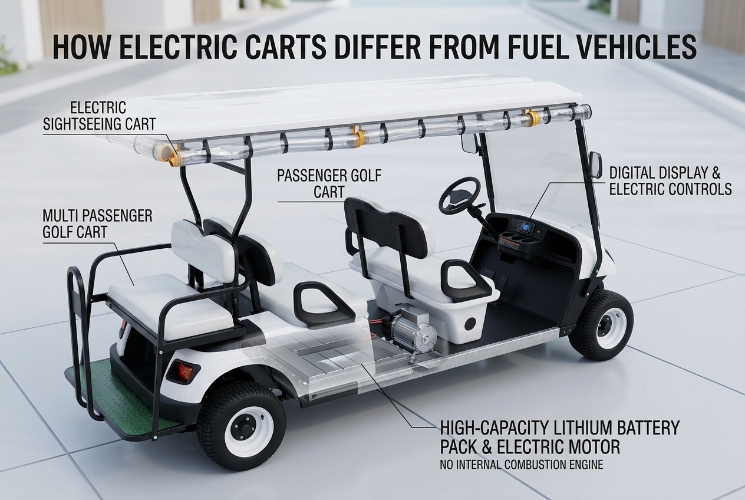
An electric sightseeing cart runs on stored energy. Staff park it at a charging point when the shift ends, much as people plug in a phone overnight. A fuel vehicle needs a dependable supply of fuel and regular engine servicing.
Both need a walk-around check each morning: tires, brakes, steering, lights, seats. Drivers should know the controls and limits of the exact vehicle they are handed.
Everyday differences show up here:
- Electric carts need charging points, and fuel vehicles need a fuel supply close by.
- Charging time has to fit into the schedule for electric models. Fuel models need time set aside for refueling and engine work.
- A cart with a drained battery sits idle, and so does a fuel vehicle with a mechanical fault.
- Smooth acceleration and gentle braking reduce wear on either type and make the ride kinder to passengers.
Delays usually trace back to planning gaps, not the drivetrain. A site that charges carts during the midday lull can keep service steady through the afternoon rush.
Which Vehicle Suits Short Shuttle Routes?
Short routes mean repeated hops: parking area to entrance, hotel wing to restaurant, park gate to a garden. Each passenger change adds a small pause, and the vehicle spends much of its day starting and halting.
A Passenger Golf Cart copes with this pattern when the route matches its size and seating. It turns in tight corners and stays close to boarding points, which keeps crowds off the path. A larger fuel vehicle can serve short routes as well, particularly for a big group traveling together, but it needs wider lanes and more turning room.
A few practical questions help sort the choice:
- Are the paths wide enough for the vehicle?
- Can passengers board without blocking a walkway?
- Does the route include slopes, tight bends, or narrow gates?
- Does demand stay steady, or does it surge after a show or tour ends?
- Where can the vehicle wait, park, and recharge safely?
An electric sightseeing cart fits frequent short trips in quiet zones. A larger fuel vehicle fits routes that need more seats or longer range. Plenty of sites run both.
How Do Capacity and Comfort Affect the Choice?
Capacity decides how many trips a service has to make. Small groups ride easily by cart. A busy site may need several carts or a larger vehicle to keep queues short. A Multi Passenger Golf Cart gives families, tour parties, and hotel guests a shared ride between nearby points, as long as the stated passenger limit is respected.
Comfort goes beyond seat count. Step height, ride smoothness, shade or weather cover, and room for small bags all shape the experience. A grandparent traveling with young grandchildren notices a high step right away, even if the spec sheet never mentions it.
| Passenger Need | Point to Consider |
|---|---|
| Small groups | Compact cart suits short internal trips |
| Large tour groups | Larger vehicle may cut the number of trips |
| Older visitors | Check step height and seat comfort |
| Mobility needs | Confirm ramps, securement, and boarding help |
| Visitors with bags | Storage must stay within safety limits |
Not every cart meets accessibility needs. Some passengers require a ramp or a securement area that a given model does not offer. Managers should compare vehicle features with local requirements before promoting the service to visitors.
What Differs in Noise, Emissions, and Visitor Experience?
People visit gardens, heritage districts, and nature reserves for calm. Engine noise and exhaust work against that mood. An electric cart gives off no direct exhaust and usually runs more quietly than a fuel vehicle, though tire noise, road surface, and warning beeps still add sound.
Electric power has a wider footprint than the tailpipe alone suggests. Electricity generation, battery production, and disposal at the end of a battery's life all count. Swapping some fuel trips for well-managed electric ones still cuts exhaust along walking paths, where visitors and staff spend their time.
Fuel vehicles produce engine noise and exhaust while running. The real effect depends on vehicle condition, driving style, and surroundings. They remain a sensible option where seating or range matters more than a hushed ride.
A quiet cart does little good if visitors cannot find the boarding point. Clear signs, a simple route map, a friendly driver, and reliable timing shape the visit as much as the motor does.
How Do Maintenance and Operating Costs Compare?
Energy is only one line in the budget. Inspections, repairs, spare parts, cleaning, staff hours, storage, and downtime belong in the calculation too.
Electric carts need attention for batteries, charging connections, and wiring. They skip engine oil changes and fuel-system servicing, though battery condition affects long-term ownership. Fuel vehicles need fuel plus upkeep on the engine and related systems. Heavy loads, hills, and repeated stop-and-go driving wear down either type.
| Cost Area | Electric Cart | Fuel Vehicle |
|---|---|---|
| Energy | Electricity and charging equipment | Fuel and refueling arrangements |
| Servicing | Battery and electrical checks | Engine and fuel system checks |
| Storage | Parking with charging space | Parking with refueling access |
| Long-term cost | Battery life, repairs, usage | Fuel use, repairs, usage |
A fair comparison starts from the real route and timetable. A vehicle making many short trips has a different cost profile from one hauling groups across long distances. Regular checks, written driver procedures, and tidy service records cut down on surprise breakdowns for both.
Can Scenic Areas Combine Both Vehicle Types?
Many already do. Compact electric carts handle short transfers in quiet visitor areas. Larger fuel vehicles take longer routes or bigger groups where access rules allow. A resort might run carts between rooms, restaurants, and the pool, and keep a larger vehicle for the drive to a distant viewpoint. A park might use carts for internal transfers and assign other vehicles to maintenance work.
A mixed fleet works when the rules are plain. Routes go to the vehicle that suits them, based on demand, safety, and access limits. Drivers and dispatch staff should know where each vehicle may run and where passengers board.
A sensible way to organize it:
- Map the destinations that need passenger transport.
- Separate short internal routes from longer or higher-capacity ones.
- Check access, turning space, and boarding conditions along each route.
- Plan charging, refueling, parking, and maintenance together.
- Post route information where visitors will see it.
- Review service records and adjust assignments when demand shifts.
This setup avoids sending a large vehicle on every short errand, and it avoids asking a compact cart to cover ground it was never built for.
What Should Buyers Check Before Choosing?
Begin with the service itself: destinations, passenger groups, operating hours, and access conditions. Walk the route and note narrow paths, slopes, pedestrian crossings, and parking space. Local rules on passenger transport also apply.
Energy logistics deserve equal attention. Electric carts need a workable charging arrangement, and fuel vehicles need refueling access. Both need trained drivers, regular inspections, secure parking, and a plan for handling faults.
Questions to settle before purchase:
- Which destinations will the vehicle connect?
- How many passengers usually travel together?
- Can it turn and move safely on the actual route?
- Are charging or refueling facilities available on site?
- What maintenance support does the supplier offer?
- Do the features meet access and safety requirements?
A demonstration run shows boarding, ride comfort, turning, and daily handling under real conditions. An electric sightseeing cart, a Passenger Golf Cart, or a fuel vehicle earns its place by fitting the route, the passengers, and the rhythm of the site.








- Building 1 and 2, No. 2269, Jingzhong Road, Hongjia Street, Taizhou, Zhejiang, China
- +86-18857621312
- [email protected]
