
 English
 русский
 عربى

How Can a Multi Passenger Golf Cart Improve Shuttle Flow
2026-10-27
A long walk between the parking area, the ticket office, a garden, and a viewing platform can wear visitors down before they reach the attractions they came for. Families with small children, older travelers, and people carrying bags feel this most. A well-planned shuttle service changes how a site feels, because visitors spend their energy on the destination instead of the distance.
A Multi Passenger Golf Cart suits short internal transfers where a full-size bus would be hard to maneuver or unnecessary. It is compact, electric, and made for frequent boarding and exits along approved paths. Hotels, resorts, parks, and event venues use the same approach. How well it works depends on passenger demand, route conditions, charging arrangements, and how the service fits into daily operations.
Why Does Shuttle Efficiency Matter in a Scenic Area?
Scenic areas usually spread attractions across a large site. A typical visit might run from the parking area to the ticket office, then to a lookout point, and finally to a restaurant or activity zone. Where these places are far apart, transport shapes how much of the site a visitor actually sees.
Efficiency here means more than speed. A clear route, short waits, and vehicles matched to demand matter just as much. A cart that runs on schedule but follows a confusing loop can still frustrate passengers.
Common site problems and the shuttle responses that address them:
| Site Challenge | Shuttle Response |
|---|---|
| Long walking distances | Link attractions and service areas with regular transfers |
| Frequent passenger changes | Use short trips between marked stops |
| Narrow internal paths | Use a compact vehicle where access is permitted |
| Crowding at popular points | Move people along planned routes |
| Uneven demand through the day | Adjust the number of running vehicles |
Each row ties back to one idea: transport should fit the site, not the other way around. A shuttle should not disturb the natural surroundings or the activities nearby.
How Do Multi Passenger Golf Carts Handle Frequent Stops?
Scenic shuttles rarely run long, uninterrupted trips. A family may board at the entrance, get off at a flower garden, and ride again later to a lunch area. During busy hours, a cart repeats these short hops many times.
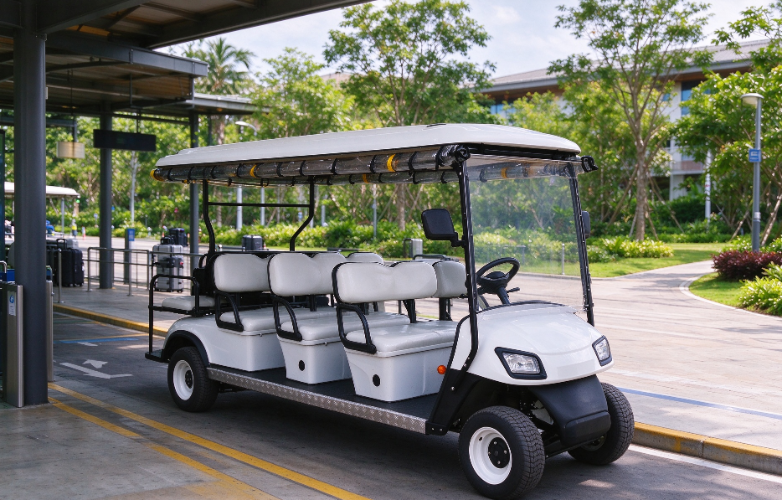
A Multi Passenger Golf Cart carries a group together, which keeps families and tour parties from splitting up. Its seating layout and open sides make boarding quick, and passengers can see their surroundings while moving. Managers can run it as a fixed loop, a scheduled route, or a link between selected stops, depending on how visitors move around the site.
Questions that shape a practical route:
- Where do visitors usually enter and leave the site?
- Which attractions receive repeated transfers?
- Where can passengers wait without blocking walkways?
- Which paths allow safe vehicle movement?
- Where can a cart pause, turn, and park?
- How does demand change between busy and quiet periods?
Clear stops make the service easy to read. Visitors know where to wait, and drivers follow a steady pattern. Drivers still need to confirm that passengers are seated and the area is clear before moving off gently.
What Makes an Electric Sightseeing Cart Suitable for Quiet Areas?
Many visitors come to a garden, heritage site, or nature area for calm. Engine noise and exhaust fumes work against that. An Electric Sightseeing Cart produces no exhaust during operation and usually runs more quietly than a fuel-powered vehicle. Actual noise still depends on the tires, the road surface, and the surroundings.
Electric operation also changes daily planning. Each cart needs a charging location and a schedule that allows for charging time. Battery condition, passenger load, slopes, and driving habits all affect how long a cart can stay in service.
Electric power does not make a shuttle environmentally friendly in every respect. Electricity sources, battery production, and maintenance all play a part. Even so, replacing short trips by fuel-powered vehicles with well-managed electric shuttles reduces direct exhaust inside the site, which visitors and staff notice near walking paths.
How Can a Passenger Golf Cart Improve the Visitor Experience?
Heat, uneven ground, and limited time can turn a pleasant stroll into a chore. A Passenger Golf Cart gives visitors a shared way to cover those stretches and keep energy for the attractions themselves.
Comfort depends on more than the seat. Easy boarding, visible stop signs, a smooth ride, and a courteous driver all count. Staff who can answer simple questions about routes help the service feel like part of the visit.
Different groups benefit in different ways:
- Families: Children and grandparents can skip long walks between activities while the group stays together.
- Older visitors and people with mobility needs: A shuttle reduces walking between selected places. Vehicle height, steps, and boarding arrangements should be checked against the needs of passengers who require extra help.
- Hotel and resort guests: Carts connect rooms, reception, restaurants, and recreation areas, which helps newcomers who do not know the layout.
- Event attendees: Carts move guests between entrances, parking, and activity zones. Clear route information matters when crowds and temporary barriers change normal movement.
How Does Route Planning Cut Waiting and Empty Trips?
A cart can be in good condition and still waste time if its route ignores real demand. Visitor flow in a scenic area comes in waves. A stop may fill up when a tour ends or an attraction opens, then sit empty for a while.
A fixed loop works when visitors move through popular locations in a predictable order. A point-to-point service fits sites where most passengers travel between the parking area and one central attraction. Some sites combine both, running a regular loop and sending extra carts to places with temporary surges. Drivers and visitors should still be able to understand the arrangement at a glance.
A practical planning sequence:
- Map destinations. Mark entrances, visitor centers, attractions, dining areas, and rest points.
- Observe movement. Note where people board, where they leave, and when crowds form.
- Choose stops. Pick spots with enough boarding space that do not block pedestrians.
- Match frequency to demand. Adjust the schedule to visitor patterns and available carts.
- Review in operation. Use driver feedback and service records to find delays and empty runs.
Stop spacing deserves attention too. Stops placed too close together cause repeated interruptions. Stops placed too far apart make the service less useful for people who struggle with walking. Some waiting is normal, since boarding and assistance take time. The goal is to remove travel that serves no passenger.
How Should Fleet Scheduling and Charging Be Managed?
When several carts share one route without a plan, some run nearly empty while other stops have long queues. Too few carts at busy periods creates the opposite problem. Managers can look at arrival times, tour schedules, meal periods, and event timing to decide how to spread vehicles across the site. A simple dispatch routine lets staff redirect a cart when demand shifts.
Charging belongs in that same plan. Carts need suitable charging points, and charging periods should be timed so important routes are never left uncovered. Following the manufacturer's charging and battery-care instructions protects both safety and service life.
| Management Area | Planning Consideration |
|---|---|
| Vehicle allocation | Match carts to expected passenger demand |
| Driver scheduling | Allow time for shifts, breaks, and handovers |
| Charging | Arrange charging around service hours |
| Parking | Keep idle carts in designated areas |
| Maintenance | Schedule inspections to limit disruption |
| Service records | Track delays, route demand, and repeat issues |
Records of waiting periods, passenger demand, and vehicle availability give managers evidence for adjustments instead of impressions. Charging and parking areas work well when they are close enough for staff but away from busy pedestrian zones.
What Safety and Maintenance Habits Keep a Shuttle Reliable?
Even at low speed, a cart shares space with walkers, cyclists, staff, and other vehicles. Slopes, tight corners, changing surfaces, and blocked sightlines add risk in scenic settings.
Drivers should follow site traffic rules and the manufacturer's operating instructions. That means controlling speed, watching for pedestrians, approaching stops slowly, and moving only when passengers are seated safely. Passenger capacity should never be exceeded, and every rider should use the safety features provided.
Paths need enough width, turning room, and visibility. Busy pedestrian areas may call for separate vehicle routes, restricted hours, or staff assistance. Local rules on passenger transport and road access also apply.
Routine inspections should follow the manufacturer's schedule and cover brakes, steering, tires, lights, seats, and any fitted restraints. Electric carts also need checks of batteries, charging connections, and wiring. Drivers can help by reporting odd sounds, changes in handling, visible damage, or charging faults right away. A cart that may be unsafe should come out of service until qualified personnel have checked it. Regular cleaning of seats and handholds keeps the ride pleasant after many passengers.
How Can a Scenic Area Choose a Suitable Multi Passenger Golf Cart?
Selection starts with the service itself. A cart for short hops between nearby attractions has different needs from one that crosses a large resort or connects a distant parking area with the entrance.
Seating capacity matters, though it should be weighed against boarding access, luggage, route conditions, and space for turning and parking. A cart that carries a group comfortably on an open path may struggle on a narrow lane with frequent pedestrian crossings. Existing transport also deserves a look. Walking routes, larger buses, service vehicles, and accessible transport may already be in place, and a cart can fill a specific gap without replacing any of them.
Points to check before buying:
- Seating arrangement and passenger capacity
- Boarding access for the intended visitor groups
- Suitability for the site's roads and paths
- Expected travel distance and charging needs
- Storage, parking, and charging space
- Availability of maintenance support and spare parts
- Compatibility with site rules and local transport requirements
- Ease of driver training and daily use
A site visit or short trial run shows how a cart handles real turns, passenger boarding, ride comfort, and pedestrian areas. When demand, route design, charging, safety, and upkeep are planned together, an Electric Sightseeing Cart or Passenger Golf Cart becomes a dependable part of everyday visitor transport.







- Building 1 and 2, No. 2269, Jingzhong Road, Hongjia Street, Taizhou, Zhejiang, China
- +86-18857621312
- [email protected]
