
 English
 русский
 عربى

Does a Lightweight Stand Up Paddle Board Make Paddling Easier
2026-11-24
A day on the water often starts with a walk from the car park, a board under one arm, and a bag of gear in the other hand. That walk shapes how the whole outing feels. A Lightweight Stand Up Paddle Board eases the work of carrying, launching, and storing, but weight is only one part of the picture. Construction, width, rigidity, and load capacity all decide how the board behaves once it touches the water. Looking at the full set of characteristics helps paddlers pick equipment that suits their routine instead of chasing a single number on a label.
Why Board Weight Matters for a Lightweight Stand Up Paddle Board
Weight affects how easily a board can be moved, positioned, launched, and put away. The effort adds up before and after a session, especially for people who paddle alone.
For casual paddlers, convenience often decides how frequently the board gets used. A heavy board can turn a spontaneous afternoon at the lake into a chore. A lighter one makes short outings easier to organize.
Everyday Handling Beyond the Water
A board spends a surprising amount of time out of the water. It moves between storage, vehicles, parking areas, beaches, and launch points.
Typical moments where weight shows up:
- Carrying the board across a car park
- Walking along a sandy shoreline
- Lifting it onto a roof rack
- Setting it down at the water's edge
- Returning it to the garage after a rinse
A manageable weight makes these tasks less tiring. It also opens paddling to beginners, families, and people who prefer to go out on their own.
Lightweight and Heavier Boards Differ in Approach
A lighter board puts portability first. A heavier one may reflect different materials or added structural support. Weight alone does not decide quality, so the build and intended use matter more than the label.
Carrying: Where Lightweight Design Shows Its Value
Carrying is where the gap between light and heavy boards becomes obvious. Even a short walk to the water feels long when the board is awkward to lift or hold.
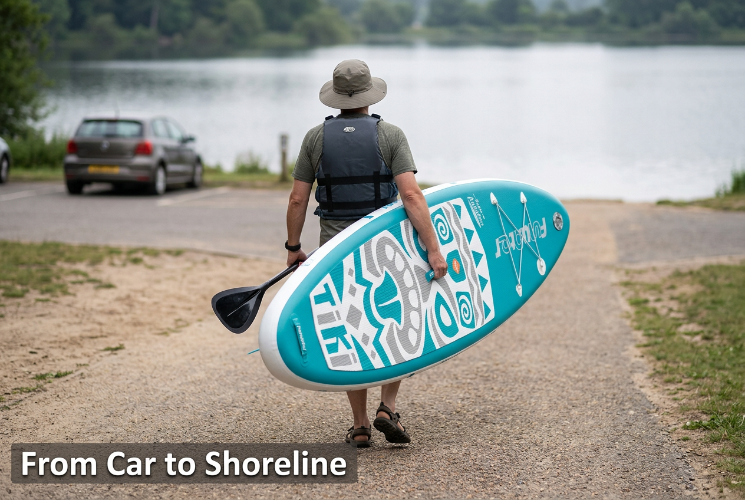
From Car to Shoreline
Picture arriving at a quiet lake with a paddle, a life jacket, a dry bag, and a water bottle. The board still has to travel from the vehicle to the edge of the water.
- Car parks: a manageable board is easier to carry over paved ground.
- Sandy beaches: less weight makes repeated lifting less tiring on soft footing.
- Narrow paths: an easily handled board copes better with tight spaces.
- Vehicle loading: lifting onto a rack takes less effort.
Handle placement matters as much as weight. A light board with an awkward grip can feel worse to carry than a slightly heavier one balanced well.
Convenience for Solo Paddlers
Paddling alone means choosing your own place and pace. It also means nobody is there to help with lifting. A lighter board makes it simpler to take the board out of storage, carry it to the water, adjust its position, and bring it home again.
Beginners benefit too. Fewer physical hurdles before entering the water leave more attention for balance and paddle technique.
Storage After the Session
The job does not end on the shore. The board must be rinsed, dried, moved, and stored. Apartment dwellers and anyone with limited garage space will notice the difference when a board is easy to reposition and fits a practical storage spot.
Launching With a Lightweight Stand Up Paddle Board
Launching involves crossing the shoreline, finding a safe entry point, and positioning the board before stepping on. Weight influences each of these steps, particularly where the ground is uneven.
Sand, Rocks, and Narrow Access Points
| Launch Setting | Handling Challenge | Benefit of a Lighter Board |
|---|---|---|
| Sandy beach | Soft ground underfoot | Easier carrying and repositioning |
| Rocky shoreline | Careful placement needed | Less lifting effort |
| Calm lake access | Walk from parking to water | Simpler transport |
| Narrow launch area | Limited room to maneuver | Easier handling on land |
Inspect the launch area before setting the board down. Sharp objects, shallow rocks, and shifting water can damage equipment regardless of how little it weighs.
Preparing Alone
When no one is around to help, every preparation step falls on the paddler. A lighter board is easier to carry, turn, and set near the water. That reduces stress for a first-time paddler. It also suits spur-of-the-moment trips to a local lake, where complicated logistics would otherwise discourage going.
Weight Is Not the Only Factor
A light board does not automatically launch easily. Other details contribute:
- A well-placed carrying handle
- A shape that is easy to control on land
- A practical fin attachment system
- A width that suits the user
- A construction style suited to the location
Paddling Performance and Board Weight
On the water, the effect of weight is less direct than on land. Speed, tracking, and comfort depend on several design features working together.
Acceleration and Handling
Each stroke pushes the board through the water. A lighter board needs less effort to lift and turn on shore. Afloat, the combined load of board, paddler, and gear determines how it accelerates. Hull shape and water resistance also play a part.
A lightweight design can feel responsive, though it does not promise greater speed with every stroke.
Does a Lighter Board Move Faster?
Not necessarily. Length, width, hull shape, water conditions, and technique all influence speed. A long, streamlined board can glide efficiently even when it is not especially light. A wide recreational board offers a relaxed platform but creates different resistance in the water. Weigh the whole design instead of the weight figure alone.
Shape, Rigidity, and Stability
A board must hold its intended shape under the paddler's weight. If construction lacks adequate rigidity, the board may feel less controlled.
| Characteristic | Possible Effect on Paddling |
|---|---|
| Board weight | Handling and transport |
| Length | Tracking and glide |
| Width | Stability and resistance |
| Thickness | Volume and structure |
| Rigidity | Support and responsiveness |
| Hull shape | Water movement and steering |
Light does not mean stable. Stability comes from dimensions, shape, volume distribution, and the paddler's stance. A wider board often feels reassuring to beginners, while a narrower one suits those who prefer maneuverability. Check the intended use, dimensions, and recommended capacity instead of the weight label alone.
Choosing Between Light and Heavier Boards
The choice depends on how often you transport the board, how you launch, and where you paddle.
What Lightweight Boards Offer
A Lightweight Stand Up Paddle Board brings practical gains across preparation and transport:
- Easier movement between vehicle and launch point
- Less effort when carrying alone
- Simpler positioning along the shore
- Easier lifting during loading
- Less strain during cleaning and storage
These matter most to casual paddlers who take short trips on local waterways.
When a Heavier Board Fits
Some users prefer boards with extra material or reinforcement for a specific paddling environment. Added weight should not be read as added durability, though. Material quality, seams, and construction method need separate evaluation.
Weight and Durability Together
A portable board still needs support suited to its purpose. When comparing products, look at:
- Material quality and construction
- Surface resistance to everyday wear
- Structural support under the recommended load
- Fin and accessory attachment points
- Manufacturer care guidance
How to Choose the Right Lightweight Stand Up Paddle Board
Start with how you plan to use the board, then follow the whole path from storage to water.
Your Carrying Needs
Ask a few practical questions. Do you carry the board alone? Is the launch point close to the car? Is there a long walk over sand or through a park? The answers show how much portability should weigh in your decision.
Your Paddling Environment
| Environment | Features to Consider |
|---|---|
| Calm lakes | Stability and comfortable handling |
| Slow rivers | Maneuverability and sturdy construction |
| Coastal areas | Suitable design for changing conditions |
| Beach recreation | Portability and quick setup |
| Travel trips | Manageable weight and compact storage |
Confirm that the board is designed for the conditions you intend to meet.
Materials and Construction
Inflatable boards appeal to people who value transport and storage convenience, since a deflated board fits into a carry bag. That helps when vehicle space is limited. Rigid boards handle differently, and their suitability depends on storage and transport options. Neither type suits everyone.
Capacity and the Complete Package
Board weight and weight capacity are different things. The first describes the equipment. The second describes the load it is designed to support. Add up the paddler, clothing, water bottles, dry bags, and any accessories, then follow the manufacturer's recommended capacity.
The pump, bag, paddle, and leash add to what you carry. Judge the complete package, not just the board. Comfortable straps and a practical storage bag make regular transport easier.
Who Benefits From a Lightweight Stand Up Paddle Board
- Beginners: new paddlers already juggle balance, paddle grip, and steering. Easier handling simplifies preparation. Width, stability, and capacity still deserve attention.
- Solo paddlers: people who handle every stage of the outing themselves appreciate a board that is simple to move, launch, and store.
- Travelers: road trips, camping, and beach visits favor portable gear. An inflatable lightweight board can fit into a travel setup, provided storage space and setup time are considered.
Plan Your Next Paddle Session
A board should fit the way you spend time outdoors. From crossing a beach to setting up at a lake, manageable weight makes each step more convenient, while construction and stability determine how the session itself feels.
If you are comparing a Lightweight Stand Up Paddle Board, examine its construction, carrying design, recommended capacity, and intended environment. Explore our lightweight SUP range, compare the features that matter to your plans, and choose a board that makes the trip from storage to shoreline simpler.





- Building 1 and 2, No. 2269, Jingzhong Road, Hongjia Street, Taizhou, Zhejiang, China
- +86-18857621312
- [email protected]
