
 English
 русский
 عربى

Can a Lightweight Stand Up Paddle Board Suit All Waters
2026-11-27
Choosing a board for open water starts well before the first stroke. It begins with the walk from the car, the space available at home, and the kind of water you plan to visit. A Lightweight Stand Up Paddle Board eases transport and storage, yet weight is only one part of the decision. Width, length, construction, load capacity, and local water conditions all shape how a board behaves. Matching these factors to a lake, a coastal bay, or a gentle river helps you select equipment that suits your routine and skill level.
Why Choose a Lightweight Stand Up Paddle Board
Many paddlers fit outings into weekends, short breaks, or travel days. Equipment that needs a roof rack, a garage, and two people to lift often stays at home. A lighter board removes much of that friction, and inflatable versions can be deflated and packed into a bag after use.
Easier Transport Keeps Plans Flexible
Carrying a board across a car park, down a trail, or along a pebbly shoreline gets tiring quickly when the load is awkward. A lighter board helps, particularly for solo paddlers with nobody nearby to share the lift.
When comparing products, check:
- The actual board weight, not only the wording in a description
- Whether the carrying handle is comfortable and well placed
- Whether a storage backpack is included
- How easily the packed board fits in your vehicle
- How simple inflation and packing are for regular use
Light Does Not Mean Unstable
Stability depends on width, thickness, shape, and construction quality. A lightweight board with a suitable width and balanced design gives a comfortable platform for recreational paddling. A narrow board can feel unforgiving to a beginner, whatever it weighs. Judge the complete design instead of the weight alone.
Activities a Versatile Board Can Support
- Relaxed paddling on calm freshwater
- Exploring sheltered coastal areas
- Gentle river routes
- Short fitness sessions
- Time outdoors with family and friends
Pick features for the activities you will actually do, not for ones you might try someday.
Matching a Lightweight Stand Up Paddle Board to Water Conditions
Each environment asks something different of a board. Knowing where you will paddle narrows the choices quickly and prevents a mismatch between equipment and use.
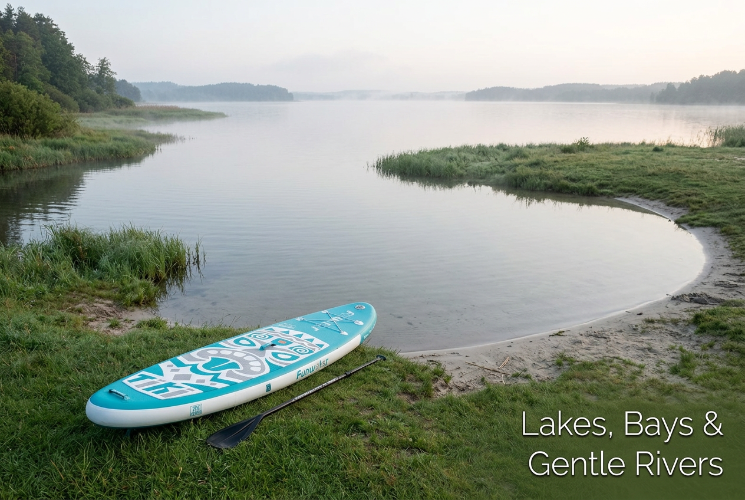
Lakes: Stability and Easy Handling
Sheltered lake areas often offer calm water for relaxed exploration and casual exercise. An all-around board suits this setting, since its balanced shape supports general recreation instead of one specialized style.
Look for:
- A wider standing area for comfortable balance
- A shape that turns and steers easily
- Enough capacity for the paddler and belongings
- A deck surface with secure footing
- Convenient carrying and storage
Wind can still ripple open lake water. Check conditions before setting out and choose a route that matches your experience.
Bays: Directional Control and Changing Conditions
A bay can look peaceful from the shore while wind, tides, and boat traffic change the water. Tracking matters more here. A longer board tends to hold a straighter line, and a suitable width keeps the standing platform comfortable.
Consider:
- A shape built for efficient forward movement
- A fin setup that supports directional control
- Stability appropriate to expected conditions
- Durable construction for regular outdoor use
- A carrying system that eases access to launch points
Open coastal water can bring currents and shifting weather. Favor sheltered locations and stay within your skill level.
Rivers: Maneuverability and Realistic Expectations
Moving water, shallow sections, rocks, and fallen branches affect how a board handles. An inflatable board is convenient for reaching varied access points when transport and storage space are limited.
Portability does not make a board suitable for every river. Look for:
- A shape that allows controlled turning
- Construction that suits the intended environment
- Fin options appropriate for water depth
- Secure storage for gear
- A design matching your experience
Gentle waterways suit a versatile recreational board. Fast or technical sections call for specialized equipment, training, and safety preparation, and a general-purpose inflatable should not be assumed suitable for whitewater.
Environment Comparison
| Factor | Lakes | Bays | Rivers |
|---|---|---|---|
| Main concern | Stability | Directional control | Maneuverability |
| Board style | All-around | Touring or versatile | Adaptable recreational |
| Shape | General-purpose | Efficient forward movement | Responsive handling |
| Storage | Convenient transport | Portable travel setup | Easy access to launch points |
Treat this as a starting point. Local conditions, experience, and planned activities should shape the final choice.
Features to Compare Before Buying a Lightweight SUP
A board can look appealing online and still fall short for your needs. Comparing specifications helps confirm that construction fits your intended use.
Weight and Portability
Think about how you will move the board, where you will inflate it, and where it will be stored. For inflatable models, confirm that a backpack, pump, and removable accessories come in the package. A simple packing routine often decides whether a board gets used regularly or sits in a closet.
Length and Width
Longer boards generally track well and move efficiently. Shorter ones turn more easily. A wider platform adds stability but can increase water resistance, while a narrower one moves efficiently and asks more of your balance.
| Characteristic | Potential Benefit | Consideration |
|---|---|---|
| Wider shape | Comfortable platform | More resistance |
| Narrower shape | Efficient movement | Needs balance skill |
| Longer shape | Tracking | Harder to turn |
| Shorter shape | Responsive handling | Less efficient over distance |
Height, body weight, experience, and water conditions should guide the choice.
Weight Capacity
Capacity covers more than the paddler. Clothing, water bottles, dry bags, cameras, and fishing gear all count toward the load. Compare the manufacturer's stated capacity with your combined body and equipment weight, and confirm the deck has room for belongings.
Materials and Construction
Many inflatable boards use reinforced PVC and drop-stitch construction, which holds the board's shape when inflated according to instructions. Pay attention to material reinforcement, seam construction, deck surface durability, valve design, and care guidance. Proper inflation, rinsing, drying, and storage extend service life.
Inflatable or Hard: Which Lightweight Stand Up Paddle Board Suits You
The choice usually comes down to transport, storage, and intended use. Neither style suits every paddler.
Inflatable Boards
An inflatable board deflates, dries, and folds into a carrying bag. This suits apartments, small cars, and people who visit different waterways. It does need inflating and a quick inspection before each outing.
Hard Boards
A rigid board keeps its shape without inflation and may appeal to paddlers with storage space and a vehicle rack. Size makes everyday transport less convenient, so consider whether you can handle it alone.
Inflatable and Hard Board Comparison
| Feature | Inflatable | Hard |
|---|---|---|
| Storage | Packs into a bag | Needs dedicated space |
| Transport | Easy when deflated | Needs a rack or large vehicle |
| Preparation | Inflation required | Basic inspection only |
| Home storage | Space-saving | Takes more room |
For flexible outdoor plans, an inflatable Lightweight Stand Up Paddle Board often fits naturally into daily routines.
Experience Level and Board Selection
A board should suit your current ability and leave room to improve.
- Beginners: a stable all-around board with a comfortable standing area, textured deck, and suitable capacity makes learning easier. Learn steering, stopping, and falling safely before visiting unfamiliar places.
- Recreational paddlers: versatility matters more than specialization. An all-around inflatable suits calm lakes, sheltered bays, and gentle waterways.
- Experienced paddlers: distance, pace, and conditions shape preferences. A touring design may suit longer routes, while a responsive shape suits tighter maneuvering.
Accessories and Specifications to Review
Review the complete package instead of assuming every accessory is included.
| Accessory | Purpose | What to Check |
|---|---|---|
| Paddle | Moving and steering | Adjustable length, comfortable grip |
| Pump | Inflation | Compatibility, ease of use |
| Backpack | Carrying | Comfortable straps, space |
| Fin | Directional control | Attachment system |
| Leash | Keeps board nearby after a fall | Suits the water environment |
| D-rings | Attaching accessories | Secure mounting |
Select safety equipment according to local regulations and conditions. A suitable personal flotation device is part of every outing.
Before ordering, review board dimensions, actual weight, load information, materials, inflation and care instructions, included accessories, and warranty coverage.
Selecting a Lightweight Stand Up Paddle Board for Your Water
A suitable board fits where you paddle, how you transport it, and what you enjoy doing. Stability, construction, capacity, and storage convenience matter alongside weight.
Compare Lightweight Stand Up Paddle Board options against your intended water, load, and storage space. Review specifications and accessory packages carefully, then choose the design that fits your routine on the water.




- Building 1 and 2, No. 2269, Jingzhong Road, Hongjia Street, Taizhou, Zhejiang, China
- +86-18857621312
- [email protected]
