
 English
  русский
  عربى
عربى 
How Does an Amphibious Vehicle Work Across Land and Water Environments
2026-05-22
An Amphibious Vehicle sits in an unusual space between road transport and water travel. That alone makes it interesting, but the real value is in the way it handles two very different environments without asking the driver to change vehicles. On land, it has to behave like a road machine. In water, it has to deal with floating, steering, and movement in a medium that offers far less support.
That shift sounds simple on paper. In practice, it depends on how the body is shaped, how movement is delivered, and how the vehicle reacts when the surface underneath changes. A good design does not just move from one mode to another. It keeps the transition controlled, steady, and usable in real conditions.
What Makes an Amphibious Vehicle Function Smoothly Between Road and Water Environments
The main challenge is not motion itself. It is continuity. A vehicle can move on land, and it can move on water, but switching between those two without awkward pauses takes careful planning.
On the road, grip matters. Tires or tracks need a solid surface to push against. Once the vehicle reaches water, that same kind of contact disappears. Movement then depends on how force is redirected into the water instead of the ground.
A few things tend to matter most here:
- The body needs to handle the change in support without feeling unstable.
- Water entry should be gradual enough to avoid a sudden shift in balance.
- Movement systems need to change role without making the driver manage too many steps.
- The transition should feel controlled rather than forced.
When these pieces work together, the change from road use to water use feels more natural. That is usually what people notice first, even if they do not think about the mechanics behind it.
How Amphibious Vehicle Design Manages Stability and Balance When Entering Water
Stability becomes more noticeable the moment the vehicle leaves the ground. On land, the surface carries the weight. In water, the body begins to float, and that changes everything about how balance behaves.
A well-shaped body helps the vehicle settle into the water in a steady way. If the weight is placed poorly, one side can dip more than the other, which makes the vehicle harder to control. If the structure is balanced, the transition feels calmer and easier to manage.
There is also the question of what happens as the vehicle enters the water. A sudden drop is not the same as a slow move through a shoreline or ramp. That is why the design has to account for the change in support as much as the movement itself.
| Situation | What the vehicle is dealing with | What the design needs to do |
|---|---|---|
| Driving on land | Firm surface support | Keep movement steady and familiar |
| Entering water | Changing weight support | Prevent tipping and sudden shifts |
| Floating in water | Support comes from buoyancy | Hold position with balance in mind |
In real use, these stages are close together. That is why balance is not a single feature. It is the result of body shape, weight placement, and the way the vehicle enters the water.
What Propulsion Methods Are Used in Amphibious Vehicles and How They Change in Water Mode
Once the vehicle is in water, the job of moving forward changes completely. A wheel can push against a road, but it does not work the same way in water. The vehicle needs another method to generate forward motion.
That is where the propulsion setup becomes important. On land, the movement comes from direct contact with the surface. In water, motion has to be created by pushing against the fluid around the body. The same power source may still be involved, but the way that power is used is different.
In practice, the change usually feels like this:
- On land, the vehicle depends on surface grip.
- In water, it depends on thrust.
- The driver should not have to manage a confusing sequence during the switch.
- The system should move from one mode to the other without breaking the flow.
The key point is not only that the vehicle can move in both settings. It is that each setting asks for a different kind of movement logic. That is what makes the propulsion system such a central part of the overall design of an Amphibious Vehicle.
How Weather Water Depth and Current Conditions Influence Amphibious Vehicle Performance
Even a well-built vehicle still has to deal with the environment. Water is not a fixed surface, and that makes it less predictable than a road. A calm area can feel manageable, while moving water can change the way the vehicle behaves from one moment to the next.
Water depth affects how the body sits in the water. Too shallow, and the vehicle may not move cleanly. Deeper water changes how the body floats and how much resistance it meets. Neither condition is ideal in every case. What matters is how the vehicle responds to the setting it is placed in.
Current is another factor that shapes the experience. A still area allows more direct control. A moving current can nudge the vehicle off course or make steering feel less direct. Weather also plays a role, since wind, surface movement, and visibility can all affect operation in ways that are easy to underestimate.
A simple way to think about it is this:
- Calm water gives more predictable handling.
- Shallow areas can limit movement and create uneven behavior.
- Moving water asks for more attention during steering and entry.
- Changing weather can affect control even before the vehicle reaches the water.
For that reason, performance is not only about the vehicle itself. It is also about reading the surrounding conditions before and during use.
What Safety Features Help Vehicles Operate More Reliably in Water Environments
Safety becomes more noticeable once the vehicle is no longer supported by a road surface. In water, small design details matter more than they do on land. A door seal, a closed body section, or a controlled entry path can shape how secure the whole experience feels.
A vehicle built for water use needs to reduce the chance of unwanted water entering the cabin or mechanical space. It also needs to stay predictable when conditions change suddenly. That is why safety is not only about avoiding problems. It is also about helping the vehicle remain steady when the environment is not steady.
| Safety area | What it supports | Why it matters |
|---|---|---|
| Sealing | Limits water intrusion | Helps protect the interior and internal parts |
| Balance control | Reduces tilting | Supports steadier movement in water |
| Entry design | Smooths the move into water | Lowers sudden strain during transition |
| Visibility | Helps the driver read surroundings | Supports better judgment in changing conditions |
These parts do not work as isolated features. They support one another. If the balance feels off, the vehicle may be harder to manage. If sealing is weak, the interior may be affected. If visibility is poor, even a well-designed vehicle becomes harder to use with confidence.
How Amphibious Vehicles Transition From Driving on Land to Operating in Water in Real Scenarios
The transition is often the part people are most curious about, because it looks simple from the outside but involves several changes at once. The driver does not just move from one surface to another. The whole vehicle begins to behave differently the moment the ground support changes.
In a real setting, the move into water usually happens in stages. The vehicle approaches the edge, begins to lose full road contact, and then shifts into a floating or semi-floating state. During that moment, control has to remain calm. The handoff between land movement and water movement should feel deliberate, not abrupt.
A common pattern looks like this:
- The vehicle reaches the water entry point.
- Ground contact gradually decreases.
- The body begins to rely more on buoyancy.
- The movement system changes from road motion to water motion.
- Steering and speed control adjust to the new surface.
This process matters because each stage has its own demands. A transition that feels smooth on paper can still become difficult if the entry angle is poor or the surrounding water changes too quickly. That is why the shift between surfaces is one of the clearest tests of practical design.
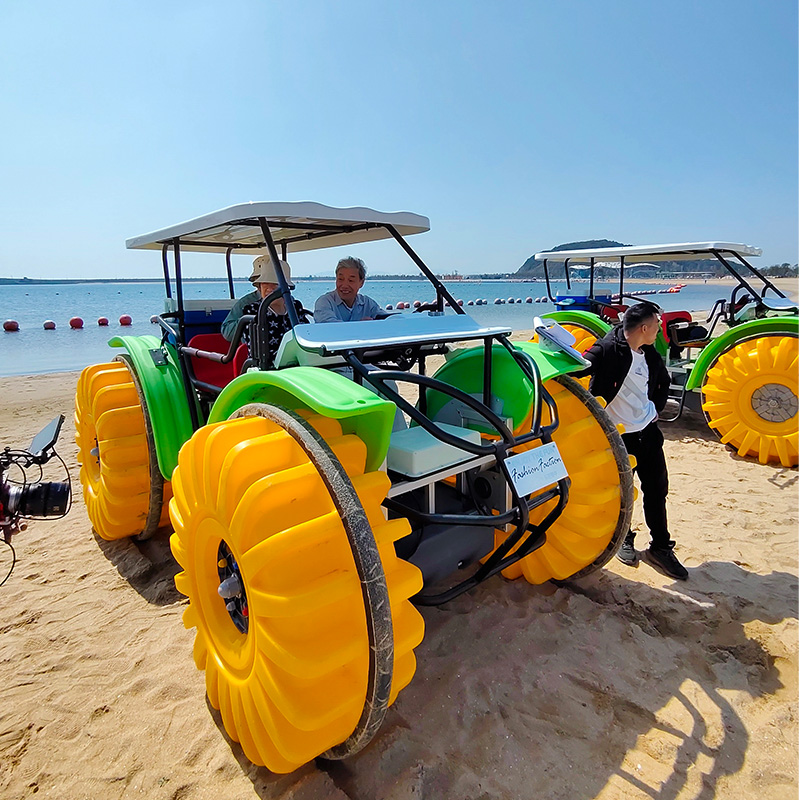
Where Amphibious Vehicles Are Commonly Used in Real World Applications Such as Rescue and Exploration
Use cases usually shape how people judge a vehicle. In this case, the appeal comes from access. A machine that can move across land and water can reach places that are awkward for standard road vehicles and not always convenient for boats.
Rescue work is one of the obvious examples. When roads are blocked or water spreads into areas that usually stay dry, a dual-purpose vehicle can continue moving without requiring a full change of transport. That flexibility can be useful in places where conditions shift quickly.
Exploration is another natural setting. Areas with mud, shallow water, marsh-like ground, or mixed terrain often create gaps that are hard for ordinary vehicles to cross. A vehicle with both movement modes can handle those in-between spaces with less interruption.
Typical use environments include:
- Flood-affected streets and low-lying districts
- Wetland paths and soft ground areas
- Shoreline access points
- Mixed terrain zones where road and water meet
How Vehicle Operators Can Improve Control and Handling During Water Navigation
Once the vehicle is in water, the driving mindset has to change. The steering feel is not the same as on a road, and the surface response is slower in some moments and more sensitive in others. A driver who treats water navigation like ordinary road driving may find the vehicle harder to manage.
Control improves when the operator pays attention to the movement of the water rather than only the vehicle itself. Small steering inputs tend to matter more than aggressive ones. Sudden changes can create a less stable feel, especially if the surface is uneven or the current is shifting.
A few practical habits help:
- Keep movements gradual rather than abrupt.
- Watch the water path ahead, not only the area immediately in front.
- Adjust speed with care when conditions change.
- Stay aware of how the body of the vehicle is sitting in the water.
- Avoid forcing direction changes when the water is already moving against the vehicle.
Handling in water is less about force and more about timing. The operator who reads the surface well usually has a clearer sense of what the vehicle is doing. That is what makes control feel more natural, even when the conditions are not ideal.






- Building 1 and 2, No. 2269, Jingzhong Road, Hongjia Street, Taizhou, Zhejiang, China
- +86-18857621312
- [email protected]
